
Most underwater phone kits grow the same way. You buy a housing, then a red filter because the reef looks blue, then an anti-fog kit because the port keeps misting, then a lens adapter, then a second adapter for the other lens, then a pump to check the seal. Eighteen months later the camera bag weighs more than the regulator bag and half of it never comes out on a dive trip.
The SeaTouch 6 Pro changes that arithmetic, because several of those add-ons are now built into the housing or included in the box. This is a look at what a lean travel kit looks like when the housing already covers the basics, what you should still add depending on the trip, and where cutting further stops being smart.
Four Things You No Longer Pack Separately
Start with what comes off the list. Each of these was a separate purchase, a separate pouch, and a separate thing to forget.
Shallow-water color. A snorkeling red filter ships with the SeaTouch 6 Pro. It clips straight onto the housing's lens window with no bracket and no threaded mount, and it is tuned to restore red from 0 to 10 meters. That covers snorkeling, freediving, pool sessions and the first part of most reef dives. If you have ever wondered why colors fade underwater, this filter is the cheapest fix for the top ten meters, and on this housing it costs you no extra bag space.
Fog control. The body has a built-in desiccant pad slot, and pads are in the standard package. They swap in seconds without tools. Anyone who has shot in Southeast Asia in the morning, where a cold air-conditioned hotel room meets 30 °C surface water, knows what a fogged port does to a dive.
The vacuum pump. The previous generation used a vacuum seal-test system before entering the water. The SeaTouch 6 Pro's triple-layer sealing and buttonless body remove that step: seal the phone, close the housing, get in. No pump, no valve, no spare valve o-ring, no app to pair.
The dome adapter. The housing has an integrated dome port mounting slot, so the second-generation Dome Lens mounts directly. Its window also covers the main and ultra-wide cameras at once, which means you switch phone lenses underwater without repositioning the dome.
The Core Kit
What follows travels on every trip regardless of destination. It is short on purpose.

| Item | Why it earns the space | Weight |
|---|---|---|
| SeaTouch 6 Pro housing | IPX8 to 60 m, full touchscreen control, 18 mm internal clearance | 475 g on land; about 150 g in water with an iPhone 16 Pro Max installed |
| Snorkeling red filter (included) | Color from 0 to 10 m, clips on without a bracket | Included in the box |
| Desiccant pads (included) | Keeps the lens glass clear across temperature swings | Included in the box |
| Your phone, fully charged | The camera, the screen and the editing suite | Weigh yours |
| Protective cover | Rigid anti-collision pad over the membrane, fits with accessories mounted | Weigh yours |
| Microfiber cloth and a small bottle of fresh water | Port cleaning between entries when a rinse tank is not available | Weigh yours |
The two weights in that table are the ones DIVEVOLK publishes. Everything else in your bag needs to go on a kitchen scale at home, because published accessory weights vary by revision and because a rig's real burden is the assembled system, not the sum of the marketing figures.
One item that is not in the core kit: a spare housing. On a two-week trip to a place with no dive shop, redundancy is a reasonable decision. On a weekend at a site an hour from home, it is not. Decide that by trip length and remoteness, not by anxiety.
Add by Trip Type
The rest of the kit should change with the destination. Four common patterns:

Reef and snorkeling holiday, mostly above 10 meters. Add nothing. The included red filter is designed for exactly this depth band, and the housing weighs close to neutral in the water, so you can hold it one-handed while you fin. This is the trip where the minimal kit genuinely covers everything you will shoot.
Wrecks, walls, night dives, anything below 15 meters. Light is the addition that matters. Filters stop helping once ambient red is gone, and no amount of editing recovers a color that never reached the sensor. One video light on a short arm covers a subject at close range; two lights and a tray are a different trip and a different bag. Start at dive lights and pick by the beam you actually need, not the largest number of lumens on the page. If you are shooting deeper with a wide-angle lens, the separate Internal Red Filter is tuned for 5 to 25 meters and clips inside the lens barrel so the ultra-wide keeps its full field.
Macro trip. A wet macro lens and the Expansion Clamp that holds it. The current clamp is CNC-machined aviation-grade aluminium, 275 g on land and 178 g in water, with a six-section adjustable arm that centers the lens over whichever camera your phone uses. It also has two M8 holes, so a wide-angle and a macro lens can ride together and swap underwater without unscrewing anything. Browse lenses and filters and read the lens pocket approach to switching optics mid-dive before you decide how many lenses to carry.
Split shots and over-under work. The Dome Lens. Because the mounting slot is integrated, it goes on without an adapter, which is one fewer small metal part to lose in a rinse tank.
One accessory sits outside those categories. Inside a SeaTouch housing, the phone's own volume, power and side buttons are sealed in and cannot be pressed; every input goes through your finger on the membrane. That works fine bare-handed. In 3 mm gloves or in cold water where your hands go clumsy, the answer is the Bluetooth Underwater External Shutter, which gives you a physical trigger without opening the housing. The SeaTouch 6 Pro takes it in either of two mounting positions, so one shutter serves a left-hand or a right-hand grip. If your hands are fine and you shoot bare-fingered, leave it home. A cheaper habit that solves the same problem in mild water: thin cotton finger cots, which keep a wet fingertip registering cleanly on the membrane and pack flat.
Batteries, Bags and the Airport
The travel rules are where a light kit gets heavy again. Lithium batteries in dive lights are the item most likely to cost you time at a checkpoint, and the rules are not the same everywhere.

Spare lithium batteries and power banks go in carry-on baggage with the terminals protected, and installed batteries in checked devices need the device fully powered off. The FAA PackSafe page for devices containing batteries is the plainest statement of the United States version of this. Your operating carrier can be stricter, and watt-hour limits differ, so check the airline as well through IATA's passenger baggage rules. At the checkpoint itself, an officer can still require additional inspection, which TSA's item-by-item guide says explicitly. Pack the camera kit where you can open it in ten seconds without unpacking a wetsuit.
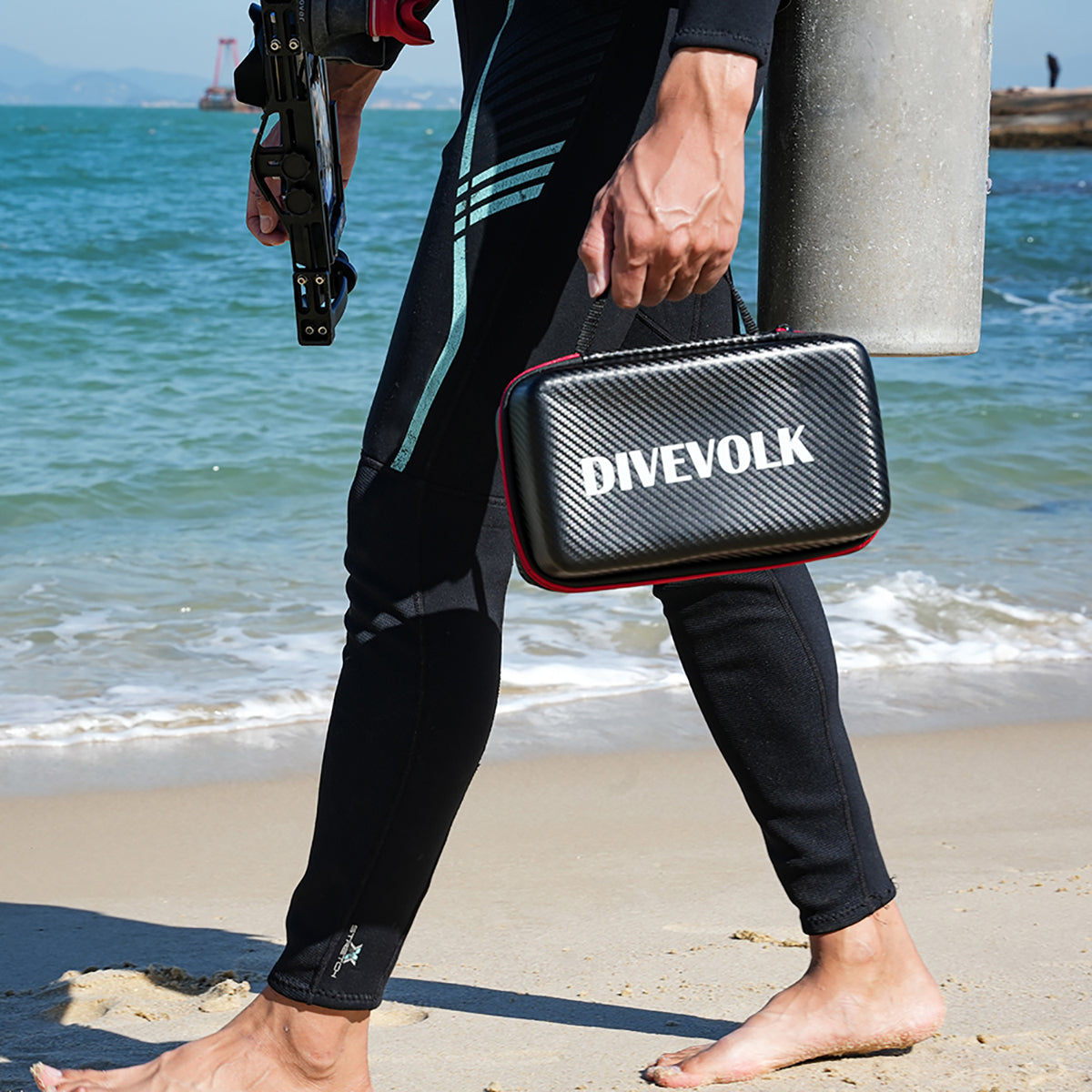
For the bag itself, the SeaTouch 6 series travel case is sized so the housing packs with the clamp, dome and lenses attached. That is worth more than it sounds. Every assembly and disassembly cycle is a chance to cross-thread an adapter or drop an o-ring on a boat deck.
Keeping a Small Kit Working
A minimal kit has less redundancy, so maintenance matters more. Rinse in fresh water after every day of diving, dry the housing fully before it goes back in the bag, and inspect the seal before the first dive of the trip rather than on the boat. The Divers Alert Network gear care guidance covers the general principles for travel storage and pre-use testing; our own o-ring maintenance guide covers the specific part that fails when it is neglected. Run through the SeaTouch setup steps once in the hotel room on arrival, not at the dive site.
Two small habits pay for themselves. Charge the phone the night before and start each dive day above 80 percent, because a phone that dies at 12 meters cannot be restarted without opening the housing. And put the phone in airplane mode with notifications silenced: a call arriving mid-shot pushes your camera app off screen at the worst moment. At the surface, cellular and GPS pass through the housing body, so you can take it out of airplane mode without opening anything if you need to check position or make a call.
Where Minimal Stops Being Smart
No single kit covers every dive. A kit built for a shallow reef will disappoint you on a 30-meter wreck, and a macro rig is the wrong tool for a manta cleaning station. The point of packing light is not to prove that one configuration handles everything. It is to stop carrying accessories that this housing has made unnecessary, so the weight you do carry is doing a job you actually planned for.
Three conditions should make you pack more, not less: a remote destination with no dive shop, a trip whose whole purpose is one specific kind of image, and cold water, where gloves change how you interact with everything. In those cases the extra kilogram is insurance, not clutter.
Confirm your exact phone model against the current compatibility and support pages before you book anything, since housing fit depends on the phone's dimensions and camera bump. When you are ready to build the kit, start with the housing at underwater phone housings, then read the full dive travel packing checklist for everything that goes in the other bag.