
Let’s say the quiet part out loud: scuba diving has real risks. But it’s not “dangerous by default.” It’s a managed-risk activity—and the difference between a calm, confident dive and a stressful one usually comes down to planning, habits, communication, and the ability to respond early before a small problem becomes a big one.
This guide is a practical, end-to-end “risk map” for recreational divers. We’ll cover what can go wrong at each stage of a dive—and what you can do to reduce the probability and severity of those problems. Midway through, we’ll also talk about a modern reality: your phone can be one of the most important safety devices on a dive trip (especially when it supports satellite emergency features on the surface), and how better underwater communication can reduce human-error risk.

Important note: This article is educational and does not replace formal training, medical advice, or local operator guidance. If you feel unwell, not ready, or out of your comfort zone—call the dive.
The Big Picture: Where Diving Risk Really Comes From
Most dive incidents don’t come from “bad luck.” They come from predictable categories that often stack together:
- Physiology & pressure (ears, lungs, nitrogen, fatigue, cold)
- Environment (current, visibility, waves, boat traffic, depth, overhead hazards)
- Equipment & gas management (out-of-air, buoyancy issues, configuration mistakes)
- Human factors (communication, decision-making, panic, task overload)
The goal isn’t “zero risk.” The goal is to reduce risk early and increase your margin of safety—so that if something unexpected happens, you still have time, air, and clarity to respond.
Part 1: The Most Common Diving Dangers (and Why They Happen)
1) Pressure injuries (barotrauma): ears, sinuses, and lungs
Ear and sinus barotrauma are among the most common dive-related injuries. They often happen when divers descend too fast, force equalization, or dive while congested. Pain is a warning—ignore it, and it can become a real injury.
Lung barotrauma and arterial gas embolism are far more serious and can occur if a diver holds their breath while ascending or rushes upward in panic. The key rule: never hold your breath, and keep your ascent controlled.

2) Decompression illness (DCI/DCS): not “only for extreme dives”
Decompression illness is linked to gas bubbles forming in tissues or blood as pressure decreases. While conservative profiles reduce risk, DCI can still occur even when a dive “seems normal,” especially when risk factors stack (dehydration, cold, exertion, repetitive dives, flying too soon, etc.). Treat unusual symptoms seriously—don’t “wait it out” on your own.
3) Running out of gas (out-of-air): the most preventable emergency trigger
If there’s one incident category divers consistently underestimate, it’s this: out-of-air problems often start as an awareness problem. Divers go too deep, stay too long, work too hard, get distracted, or fail to turn the dive at the planned pressure.
Out-of-air events can trigger a rapid ascent, panic, and a cascade of risk—especially if buoyancy control is weak.
4) Buoyancy loss and uncontrolled ascents
Buoyancy mistakes are rarely dramatic at the start—but they become dangerous during ascent. Over-inflating a BCD, losing trim, or fighting to stay down can lead to an uncontrolled ascent. That’s why buoyancy skills are not just “comfort skills.” They’re safety skills.
5) Environment hazards: current, waves, low visibility, and entanglement
Environmental conditions can turn a “simple dive” into a complex one:
- Current and surge can separate buddies, increase exertion, and spike air consumption. It is also why a current-driven destination like diving in Komodo is best planned site by site against your certification level.
- Low visibility increases navigation and separation risk.
- Entry/exit zones (waves, rocks, ladders, boat traffic) are a common place for injuries.
- Entanglement (fishing line, ropes) can escalate quickly if a diver panics.
6) Human factors: the hidden multiplier
Many incidents share the same chain: separation → stress → fast breathing → rapid air use → rushed decisions → unsafe ascent. Human factors are why communication, clear roles, and conservative decisions matter so much—especially when traveling, fatigued, or diving new conditions.
Part 2: A Full Dive Timeline Risk Map (What Can Go Wrong, and What to Do Instead)
This is where diving safety becomes practical. Use this section as a “before every trip” checklist.
Step A — Before the Dive: Planning Is Risk Reduction
Common risk points
- Diving while sick, congested, dehydrated, hungover, or exhausted
- Skipping a real dive plan (“we’ll just follow the guide”)
- Not agreeing on buddy procedures for separation, low air, and ascent
- Rushing gear setup and missing basic errors (valves, weights, hoses)
Better habits (simple, high impact)
- Use a pre-dive check (BWRAF-style or your preferred standard) and do it the same way every time.
- Agree on 3 numbers: max depth, turn pressure, and minimum reserve.
- Agree on 3 procedures: separation plan, low-air plan, and ascent plan.
- Run a “state check”: if you’re not 100%, choose an easier dive—or skip.

Step B — Entry & Descent: Pressure Changes Are When Problems Start
Common risk points
- Descending too fast and failing to equalize (ear/sinus squeeze)
- Overweighting or underweighting (hard to control descent)
- Separation in low visibility or surge
- Task overload (camera setup, new gear, nerves) before you’re stable
Better habits
- Descend slowly, equalize early and often, and stop immediately if something hurts.
- Stabilize first: get neutral and calm before you start “doing things” (photos, navigation, drills).
- Make buddy contact deliberate for the first minute: confirm OK, direction, and pace.
Step C — Bottom Time: Small Awareness Habits Prevent Big Emergencies
Common risk points
- Air consumption spikes due to stress, current, cold, or poor finning efficiency
- Navigation drift and gradual separation
- Fixating on a subject (macro, reef, camera) and ignoring gauges
- Entanglement hazards in lines or reefs
Better habits
- Instrument scan rhythm: every few minutes check gas, depth, time/no-deco status, and buddy location.
- Turn the dive on time. Do not negotiate with your remaining gas.
- Stay calm and streamlined in current; reduce effort to reduce air burn.
- Carry a cutting tool where appropriate and know how to use it without panicking.
Step D — Ascent & Exit: Most Severe Outcomes Connect to the Way You Go Up
Ascents deserve respect. A controlled ascent reduces risk for both barotrauma and decompression stress. Recreational training standards commonly emphasize slow ascents and a safety stop near 5 m / 15 ft.
Common risk points
- Ascending too fast, skipping a safety stop, or “racing” to the surface
- Holding your breath while ascending
- Uncontrolled buoyant ascent due to BCD inflation or poor trim
- Surface hazards: waves, ladders, boat traffic, exhaustion at the end of the dive
Better habits
- Ascend slowly and stay aware of your ascent rate.
- Make a safety stop (often 3+ minutes around 5 m / 15 ft) unless conditions make it unsafe.
- Breathe continuously and stay relaxed; never hold your breath.
- Plan your surface: deploy an SMB when appropriate, look and listen for boats, and exit with control.

Step E — After the Dive: The Risks People Forget
Common risk points
- Dehydration, cold, and fatigue building across multiple dives
- Flying or traveling to altitude too soon after diving
- Ignoring symptoms that appear later (tingling, unusual fatigue, pain, dizziness)
Better habits
- Recover on purpose: hydrate, warm up, eat, rest.
- Respect surface intervals and be conservative on repetitive dive days.
- Follow established guidance for flying after diving (minimum wait times vary by your profiles).

Part 3: Communication & Calling for Help — How “Small Issues” Stay Small
Many dive problems are manageable if you detect them early and communicate clearly. That’s why communication is not a “nice to have.” It’s a risk-control tool.
Layer 1: The essentials (every diver should know)
- Standard hand signals (OK, up/down, low on air, out of air, problem, stop)
- Light signals (especially for night/low-vis)
- Surface signaling: SMB, whistle, mirror/reflective signal, and staying with your buddy
Layer 2: Why your phone can be one of the most important dive safety devices
Underwater, phones are not magical. But on the surface, they can be the fastest path to help—especially when you’re diving in remote areas with limited coverage.
- Surface emergency contact: call your boat, operator, local emergency services, or alert nearby support immediately.
- Share location & situation: a quick message can coordinate pickup faster than “waiting and hoping.”
- Satellite emergency features (surface use): phones that support satellite emergency messaging can help in “off the grid” scenarios where cellular and Wi-Fi are unavailable—but they require open sky and are not a substitute for dive planning or marine safety equipment.
Key reality: satellite emergency features are for use at the surface with a view of the sky. They are not an underwater solution—and they are not guaranteed in every environment (cliffs, heavy obstruction, weather, etc.).

Layer 3: Underwater texting (clearer than hand signals in complex scenarios)
Sometimes hand signals aren’t enough—especially for multi-step instructions, gear issues, or coordinating a calm, controlled plan. In those cases, text-based communication can reduce misunderstanding—provided you have the right setup and training.
If you’re using an underwater touchscreen housing, you can treat the phone as a communication screen—typing concise messages to a buddy, a team member, or a surface support workflow (where applicable to your system and local protocols).
Layer 4: Faster than typing — voice input to the phone (speech-to-text workflow)
Typing underwater can be slow—especially with gloves, cold hands, surge, or stress. A faster option is voice input that becomes text. The concept is simple:
- Use an underwater communication setup that captures clear voice audio.
- Route that audio into a phone/camera input where appropriate.
- Use a speech-to-text workflow (where practical) so spoken words become readable text faster than typing.
This doesn’t replace dive training or standard signals. It’s an additional tool that can reduce communication friction in specific scenarios—especially when clarity and speed matter.
A practical setup example: Wireless Microphone Transmitter + full face mask communication systems
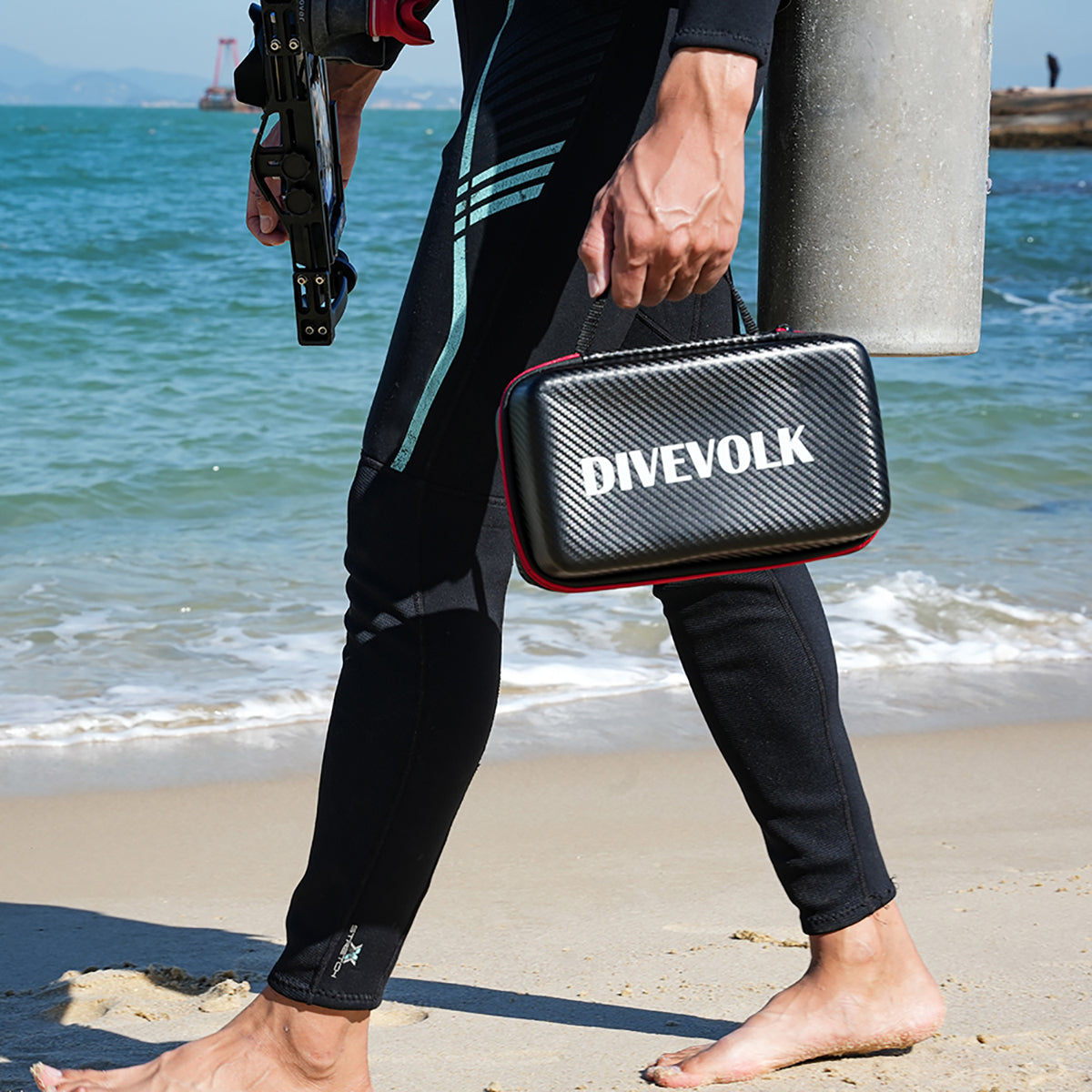
DIVEVOLK has introduced a Wireless Microphone Transmitter concept that can be used alongside certain full face mask communication ecosystems (such as those from OCEAN REEF) and units like Alpha Pro-style voice systems to get voice audio into a phone/camera input more conveniently. This can support a “voice-to-text” approach where speaking is faster than typing—while still keeping the communication readable and reviewable on-screen. Don't confuse these scuba systems with recreational full-face snorkel masks, which carry a serious carbon dioxide rebreathing risk.
Where this helps most:
- Low visibility coordination (“turn the dive,” “exit plan,” “stay together”)
- Task-heavy dives (training drills, photo/video tasks, navigation tasks)
- Stress management: reducing confusion reduces panic risk
Important: Always validate compatibility, procedures, and safety protocols with your instructor/operator. Any underwater communication tool should be treated as an aid—not a license to dive beyond your training.
Part 4: The One-Page “Safer Diving” Checklist (Save This)
Before the dive
- Am I healthy, hydrated, warm enough, and mentally calm?
- Do we have max depth, turn pressure, reserve, and a clear route?
- Do we have a separation plan and ascent plan?
- Did we do a real buddy check (air, releases, weights, final OK)?
During the dive
- Instrument scan every few minutes (gas, depth, time/no-deco, buddy)
- Turn on time—do not “borrow” from your reserve
- Stay streamlined; reduce exertion to reduce gas burn
- Communicate early; don’t wait for a “big problem”
Ascent & surface
- Slow, controlled ascent; breathe continuously
- Safety stop when conditions allow
- Surface awareness: SMB/boat traffic/waves/exit control
After the dive
- Hydrate, warm up, rest
- Be conservative with repetitive dives
- Respect guidance on flying/altitude after diving
- Take symptoms seriously; seek professional advice quickly
Final Thoughts: Diving Safety Is a System, Not a Vibe
Scuba safety isn’t about being fearless. It’s about being systematic.
When you plan conservatively, monitor your gas, control buoyancy, ascend safely, and communicate early, most “dive dangers” become manageable events instead of emergencies. And when you add modern tools—like reliable surface communication (including satellite-capable phones in remote areas) and faster underwater communication workflows where appropriate—you reduce the human-factor risk that causes so many problems in the first place.
Dive smart. Communicate early. Keep your margin. That’s how divers stay safe—dive after dive.
Sources
- DAN — Recognizing and Preventing Barotrauma
- DAN — Decompression Illness: What Is It and What Is the Treatment?
- DAN — Guidelines for Flying After Diving
- CDC Yellow Book — Scuba Diving: Decompression Illness and Other Dive-Related Injuries
- PADI Blog — The Golden Rules of Scuba Diving (safe ascent rate & safety stop)
- PADI Blog — History of the Safety Stop (5m/15ft for ~3 minutes)
- Apple Support — Use Emergency SOS via satellite on your iPhone