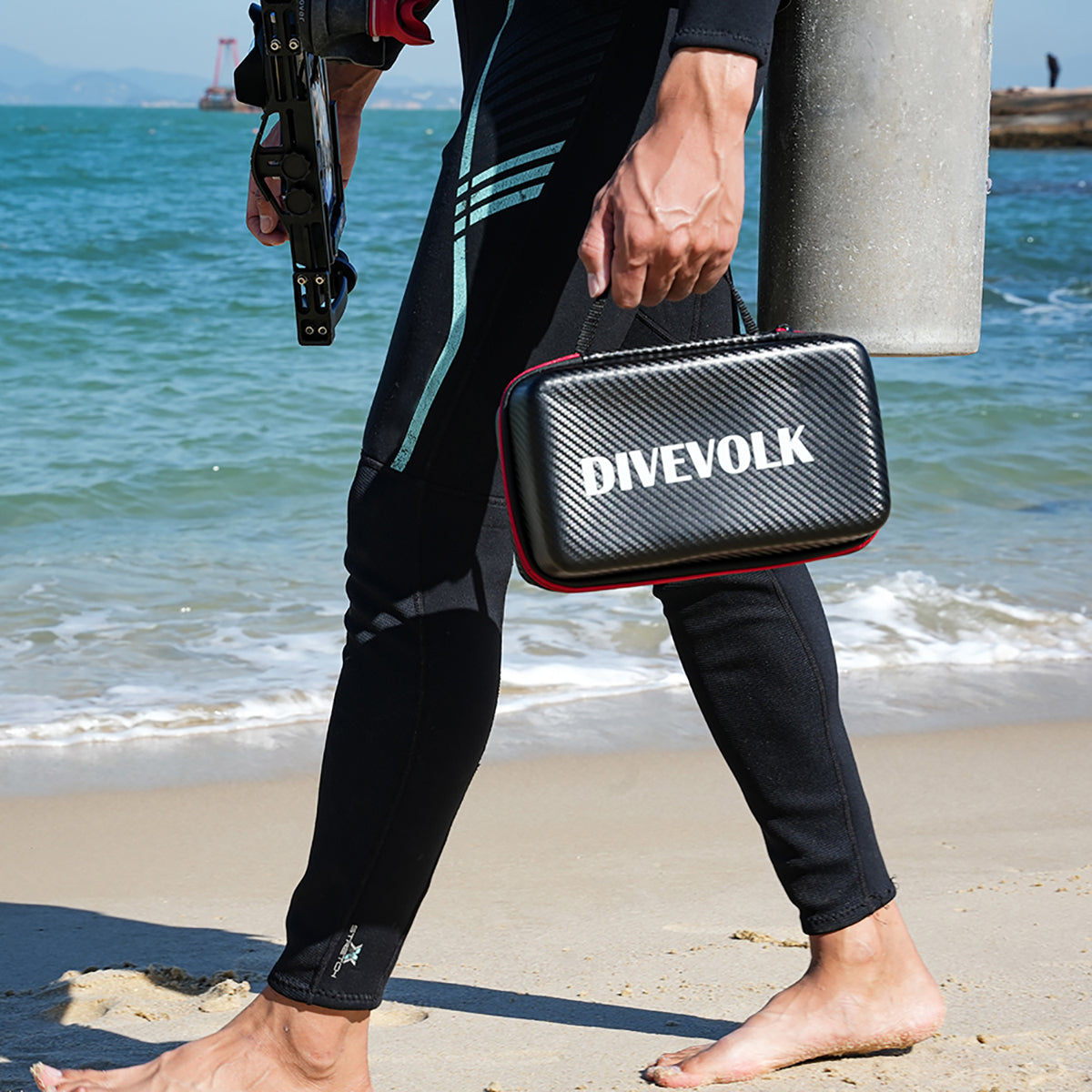

You've planned the trip of a lifetime — Komodo's manta cleaning stations, a Raja Ampat liveaboard, that bucket-list wreck in Coron. Then you start packing the camera gear, and reality hits. A traditional housing, two strobes, arms, clamps, ports, and chargers can swallow an entire carry-on and most of your weight allowance before you've folded a single rash guard. Worse, every one of those parts is a potential point of failure thousands of miles from the nearest dealer.
It doesn't have to be that way. This is a dedicated travel kit for the imaging half of your dive bag — not the general scuba checklist. (For masks, fins, regulators, and luggage-weight strategy, see our companion dive travel packing checklist.) Here we focus only on what it takes to capture great underwater images on the road while packing light, building in redundancy, and getting through airport security without a hassle.
Start With the Camera Decision: Phone, Action Cam, or Rig
Everything else in your kit flows from one choice: what captures the image. The honest answer for most traveling divers is that the lightest capable option wins, because weight saved on the camera is weight you can spend on safety gear or simply not carry at all. If you are still weighing a phone against an action cam or DSLR, our underwater camera setup comparison lays out the trade-offs.
A modern smartphone in a dedicated underwater housing shoots 4K video and large-sensor stills, fits in a jacket pocket, and weighs a fraction of a mirrorless or DSLR rig. Our underwater smartphone photography guide walks through the technique side; for travel, the headline is that the phone you already carry doubles as your camera, so there's no second device, no second charger, and no second thing to lose.
If you do shoot a dedicated cinema or mirrorless system, the packing principles below still apply — you simply have more, and more fragile, parts to protect and back up. Our Blackmagic camera underwater video guide covers that workflow in depth.
| Capture Option | Typical Travel Weight | Best For |
|---|---|---|
| Phone + housing | Under ~1 kg with light + lenses | Most divers; carry-on-only travel; social and stock-quality stills + 4K video |
| Action cam + tray | ~0.5–1.5 kg | Wide POV video, drift and fast-action dives |
| Mirrorless/DSLR rig | ~5–8 kg with ports + strobes | Pro work, large prints, demanding macro/wide-angle |
The Housing: Your Single Most Important Pack
The housing is the one item you absolutely cannot replace on a remote island, so it travels in your hand luggage, in a padded case, every time. A full-touchscreen underwater phone housing lets you operate the camera at depth without buttons or levers to fumble in gloves, which also means fewer mechanical parts to seize or flood. The SeaTouch 4 Max Platinum is built for exactly this kind of travel-and-dive cycle, and matched accessory bundles in the SeaTouch 4 Max Kits mean you aren't hunting for a missing clamp the night before a flight.

Before you ever leave home, do a dry seal check and a shallow leak test in a sink or pool. A flood discovered in your bathroom is an inconvenience; a flood discovered at 18 meters is a ruined trip.
Lighting: One Light That Earns Its Place
Water absorbs warm wavelengths with depth — red goes first, then orange and yellow, while blue penetrates deepest (NOAA Ocean Exploration explains the physics). The result is that even bright tropical scenes turn flat and blue past a few meters. A single compact video light restores those colors and doubles as your dive torch — one device covering two jobs is the essence of a travel kit. Browse DIVEVOLK dive lights for models sized to fit alongside a phone housing rather than a hard case of their own.

For travel specifically, favor a light with a sealed, rechargeable battery and a standard USB charging path so you carry one cable, not a proprietary brick. Note the battery's watt-hour rating now — it matters for the airline rules below.
Lenses and Filters: Big Capability, Almost No Weight
Snap-on optics are where smartphone shooters get an outsized return. A wide-angle attachment opens up reef-scapes and big animals; a macro attachment turns the same phone into a critter machine for nudibranchs and shrimp. The full set of lenses and filters weighs about as much as a candy bar, yet it's the equivalent of carrying two extra camera lenses.
Pack each optic in its own soft pouch or microfiber sleeve so they don't scratch each other in transit, and bring a lens cloth — saltwater spray and fingerprints kill more shots than bad light does.
Power, Charging, and Storage: Plan for No Outlets
Liveaboards and rustic dive resorts are notorious for too few outlets and unreliable power. Build your kit so a full day of shooting never depends on finding a free socket.
- Power bank (carry-on only): A 20,000 mAh pack keeps a phone and light topped up between dives. Confirm its watt-hour rating before you fly — see the next section.
- One multi-port charger + the right cables: A single compact charger with two or three ports replaces a tangle of bricks. Label cables so the light's cable doesn't disappear into someone else's bag.
- Memory, plural: Carry at least one spare card even if you shoot to phone storage; 4K video fills space fast. Keep cards in a small waterproof card wallet, not loose in a pocket.
- Offload daily: Back up to a laptop, a self-contained SSD card reader, or the cloud every evening so a single lost or corrupted card never costs you the whole trip.
Flying With Batteries: The Rules That Actually Matter
Spare lithium batteries and power banks cause real problems at security, and the rules are stricter than most divers assume. Per the U.S. FAA PackSafe guidance, spare (uninstalled) lithium-ion batteries and power banks must travel in your carry-on, never in checked baggage. Lithium-ion batteries up to 100 watt-hours (Wh) are allowed without airline approval; 101–160 Wh requires airline approval and is limited to two spares per passenger; anything over 160 Wh is forbidden in passenger baggage.
The TSA echoes this and adds a practical step: protect battery terminals from short-circuiting (keep them in original packaging, a battery case, or with tape over the contacts) so a loose battery can't touch keys or coins. A typical 20,000 mAh power bank sits around 74 Wh — comfortably under the 100 Wh line — but check the printed rating, because larger packs can exceed it. Individual airlines may impose stricter limits, so verify with your carrier before departure.
| Battery / Item | Carry-On | Checked |
|---|---|---|
| Spare power bank (≤100 Wh) | Yes | No |
| Spare camera/light batteries | Yes (terminals protected) | No |
| Battery installed in a device | Yes | Discouraged; carry-on preferred |
| Light with non-removable sealed battery | Yes | Carry-on preferred |
The Maintenance Pouch: Small Bag, Trip-Saving Contents
A flooded housing on day one of a week-long trip is heartbreaking, and almost always preventable. The single highest-value thing you can pack is a tiny maintenance pouch of seals and tools. Many gear failures trace back to neglected seals and sand in the wrong place — the same avoidable errors we cover in common dive gear maintenance mistakes.
Pack at minimum:
- Spare O-rings sized for your housing, in a labeled zip bag
- Manufacturer-approved silicone grease — a pea-sized amount per service, never petroleum-based
- An O-ring pick or removal tool (a plastic one won't scratch the groove)
- A soft brush and lint-free cloth for clearing grit from sealing surfaces
- Cotton swabs for cleaning O-ring grooves
Build a habit: rinse the housing in fresh water after each dive, then inspect and re-seat the main O-ring before the next one. A single grain of sand or a stray hair on the seal is the most common cause of a flood.
Keeping Moisture Out: Silica and Smart Storage
Humidity is the quiet enemy of a sealed housing. Warm, damp tropical air trapped inside can fog the port or, worse, condense on the phone. Toss a few fresh silica gel desiccant packs into the housing case and rotate them through the trip — many types can be dried out overnight on a sunny windowsill or near (not on) a warm surface. Seal your housing in a dry environment when you can, such as an air-conditioned room rather than a steamy dive deck.
Redundancy: What Happens If One Thing Fails
A travel kit isn't finished until you've asked, "What if this breaks at the dive site?" You can't pack a spare of everything, so spend your redundancy budget where failure is both likely and trip-ending.
- Sealing: Carry spare O-rings and grease — cheap, light, and the most common failure point.
- Storage: Carry at least one spare memory card and back up daily, so no single card holds the only copy.
- Power: Carry the power bank plus your wall charger so a dead outlet doesn't ground your camera.
- The camera itself: With a phone-based rig, your phone is the camera — guard it like your passport, and keep cloud backup turned on.
- Glass: Lens cloth and a spare pouch protect optics from scratches that no edit can fix.
Carry-On vs. Checked: A Simple Split
The rule of thumb: anything fragile, irreplaceable at your destination, or legally required to fly in the cabin goes in your carry-on. Everything sturdy and replaceable can ride in checked baggage.
| Carry-On (cabin) | Checked (if needed) |
|---|---|
| Housing, phone/camera, lenses, power bank and all spare lithium batteries, memory cards, maintenance pouch | Trays/arms, wet-dry boxes, hard cases, non-lithium accessories, cleaning supplies |
The Travel Photography Kit Checklist
Screenshot this before your next trip and check off each item as it goes in the bag.
| Category | Items |
|---|---|
| Capture | ☐ Phone or camera ☐ Underwater housing (padded case) ☐ Wide-angle lens ☐ Macro lens ☐ Lens cloth + pouches |
| Light | ☐ Compact video light (doubles as dive torch) ☐ Light mount/arm |
| Power & Storage | ☐ Power bank (≤100 Wh, carry-on) ☐ Multi-port charger ☐ Labeled cables ☐ Spare memory cards ☐ Card wallet ☐ Daily-backup drive or cloud |
| Maintenance | ☐ Spare O-rings (labeled) ☐ Silicone grease ☐ O-ring pick ☐ Soft brush + cotton swabs ☐ Lint-free cloth |
| Moisture & Protection | ☐ Silica gel packs ☐ Padded/foam case ☐ Dry bag for boat transfers |
Pack Light, Shoot Everything
The traveling underwater photographer's real skill isn't owning the most gear — it's bringing the right gear and knowing every piece will work when it matters. A capable housing, one light that doubles as your torch, a couple of snap-on lenses, smart power and storage, and a maintenance pouch the size of a sandwich bag will out-shoot a bloated rig that never makes it out of the hotel because it's too heavy to carry to the boat. Better still, a phone-based kit comes in under a kilogram, leaving your weight allowance — and your back — for the rest of the trip.
Heading somewhere with serious photo potential, like the currents and big animals of our Komodo Island diving guide? Build the kit once, refine it after each trip, and it'll serve you for years. If you're assembling or upgrading your setup, explore DIVEVOLK underwater phone housings, dive lights, and lenses and filters — and reach out via our contact us page if you need help matching a kit to your phone.