
Where you dive changes what you shoot. A macro photographer in the Maldives will spend half the trip wishing for a wide-angle lens. A wide-angle shooter in Anilao will miss nine out of ten subjects. The right destination puts the right subjects in front of your lens at the right time of year — and that single decision shapes every image you bring home.
This guide covers 15 destinations across five regions, each chosen for what it offers underwater photographers specifically. Not just "good diving" — good photography diving, meaning clear water, cooperative subjects, and conditions that reward preparation. For each: signature subjects, specific dive sites, the best window to visit, and an honest read on skill level. If you're shooting with a phone in an underwater housing, every destination here works.
For a broader overview of 2026 travel planning, see our 2026 dive destinations travel guide.
Southeast Asia
The Coral Triangle — spanning the Philippines, Indonesia, Malaysia, and Papua New Guinea — holds more reef fish species than anywhere else on earth. Warm water, low costs, and five of the fifteen destinations on this list.
1. Sipadan, Malaysia
Sipadan is a small oceanic island off Sabah, Borneo. It sits on a 600-meter volcanic cone rising straight from the Celebes Sea floor, creating a wall dive that starts at the beach and drops into blue nothing. That vertical reef structure concentrates pelagic traffic in a way that few places can replicate.

The signature shot here is the Barracuda Point tornado — a swirling column of hundreds of chevron barracuda that forms most mornings between 7 and 9 AM. It's one of the most photographed scenes in diving, and it still delivers. South Point is where you'll find white-tip reef sharks stacked on ledges during the day, while Drop Off (the main wall) gives you green and hawksbill turtles so frequently they become background subjects.
Daily dive permits are limited and shared among authorized resorts, which keeps the sites from getting wrecked but means you need to book months ahead. April through June and September through November offer the best visibility — often 30 meters or more. This is an intermediate-level destination; currents at Barracuda Point can push hard.
Read our full Sipadan diving guide for detailed site-by-site planning.
2. Dumaguete, Philippines
The stretch of coastline from Dumaguete south through Dauin is the macro capital of the Philippines. The black volcanic sand slopes off Dauin are home to species that macro photographers travel thousands of miles to find: blue-ringed octopus, mimic octopus, flamboyant cuttlefish, Ambon scorpionfish, and dozens of nudibranch species that don't have common names yet.
Dauin's muck diving sites — Atmospheres House Reef, Sahara, and Cars — are the main draw. The "cars" site is literally a collection of junked vehicles that have become artificial reef habitat for frogfish and seahorses. For something different, Apo Island is a 45-minute boat ride away and offers healthy hard coral gardens with turtle cleaning stations. Sumilon Island to the south has a seasonal sardine run (typically December to May) that produces baitball shots rivaling those from South Africa.
Dumaguete works year-round, though January through May is the driest window. This is a beginner-friendly destination — most muck dives are shallow (8-15 meters), calm, and have no current. Perfect for learning macro photography with a macro lens attachment.
Our Dumaguete diving guide covers every site in detail.
3. Anilao, Philippines
Anilao, on the Batangas coast south of Manila, is the birthplace of Philippine diving and still one of the best macro destinations in the world. But what sets Anilao apart from Dumaguete is its blackwater diving scene. After dark, the boats head to deep water over the Verde Island Passage, drop weighted light rigs to 15 meters, and wait. Larval-stage fish, siphonophores, comb jellies, and deep-sea creatures that have no business being near a camera drift up through the water column, drawn by the light.
For daytime shooting, Secret Bay, Beatrice Rock, and Basura (yes, it means "garbage" — it's a trash-slope turned macro paradise) offer pygmy seahorses on sea fans, hairy frogfish, blue-ringed octopus, and wonderpus. The coral reefs at Sombrero Island and Twin Rocks give wide-angle shooters something to work with too — healthy Acropora fields with anthias clouds.
November through June is the main season. Anilao is intermediate-level for general diving but blackwater requires comfort in open blue water at night with nothing below you — that's not for everyone. Read about the blackwater photography experience in Anilao from one of our users.
4. Raja Ampat, Indonesia
Raja Ampat holds the highest recorded marine biodiversity on the planet. The numbers are real: over 1,700 reef fish species and nearly 600 coral species have been documented in these waters. Located off the western tip of Papua, this archipelago of over 1,500 islands sits at the epicenter of the Coral Triangle, and it shows.

For photographers, the draw is range. In a single week, you can shoot manta rays at Manta Sandy (a cleaning station at 14 meters where mantas hover while cleaner wrasses work their gills), wobbegong sharks draped across hard coral tables at Melissa's Garden, walking sharks on night dives at Friwen Wall, and pygmy seahorses on sea fans at practically any site with a wall. The soft coral coverage at Cape Kri and Sardine Reef is among the densest anywhere — enormous Dendronephthya fans in pink, orange, and purple, packed so tightly the reef structure disappears beneath them.
October through April is prime season, with the calmest seas and best visibility (15-30 meters). Getting there takes effort — flights to Sorong, then a ferry or liveaboard — and permit fees add up (1,000,000 IDR (about $65 USD) for the marine park tag). Currents can be strong at the best sites, making this an intermediate to advanced destination. But nothing else on this list matches Raja Ampat for sheer photographic variety in a single trip.
5. Komodo, Indonesia
Komodo National Park sits between Flores and Sumbawa in eastern Indonesia, and the cold nutrient-rich upwellings from the Indian Ocean that sweep through its channels create some of the most action-packed diving in the Indo-Pacific. This is a wide-angle destination first — the currents bring in mantas, sharks, and fuel the enormous filter-feeder aggregations that make Komodo famous.
The must-dive sites: Batu Bolong is a pinnacle rising from 70 meters to just below the surface, encrusted with soft corals and swarming with fusiliers, trevally, and white-tip reef sharks. Castle Rock and Crystal Rock in the north get reef mantas reliably from December through February. Manta Alley in the south channel is the oceanic manta spot — these are the big ones, up to 5 meters wingspan, and they show up from March through August when the southern current is flowing.
Komodo runs on two seasons: the north sites (warmer, 27-29°C) are best from March to September, while the south sites (cooler, 22-26°C, better plankton and manta activity) peak from October to February. This is not a beginner destination. Currents at Batu Bolong and the channel sites regularly exceed 3 knots, and downdrafts are a real hazard. But if you can handle the current, the photographic rewards are hard to beat — especially with a wide-angle lens mounted.
Indian Ocean and Middle East
6. Maldives
The Maldives is 26 atolls spread across the equator, and for wide-angle underwater photography it's hard to argue against it. Visibility regularly hits 30-40 meters, water stays 27-30°C year-round, and the pelagic traffic through the atoll channels delivers manta rays, whale sharks, and grey reef sharks with a reliability that simplifies trip planning.

South Ari Atoll is the whale shark corridor — resident juveniles feed year-round and snorkel encounters here are more consistent than almost anywhere else. Hanifaru Bay in Baa Atoll concentrates manta rays (sometimes over 100 at once) during the southwest monsoon plankton bloom from June through November. Rasdhoo Atoll offers hammerhead encounters on early morning dives, while the thilas (submerged pinnacles) throughout North Malé Atoll are carpeted in soft coral and glass fish.
Best accessed by liveaboard. January through April gives the clearest water; June through November brings the mantas and whale sharks but choppier seas. See the Maldives mobile photography story and our Maldives workshop recap for what's possible with a phone setup.
7. Red Sea, Egypt
The Red Sea has a simple advantage: visibility. Forty-meter vis at sites like Ras Mohammed, The Brothers, or Daedalus Reef is normal, not exceptional. Year-round diving (21°C in February to 30°C in August) makes it one of the most forgiving environments for underwater photography.
The northern Red Sea out of Sharm el-Sheikh gives you the famous wrecks — the SS Thistlegorm (a WWII cargo ship at 30 meters, still loaded with motorcycles and trucks). South of there, the offshore reefs accessed by liveaboard are where the big-animal action is. Elphinstone Reef has oceanic white-tip sharks on almost every dive. The Brothers Islands combine wall diving with thresher sharks and hammerheads. Fury Shoals in the far south offers spinner dolphin encounters and healthy coral gardens.
The coral cover here has held up better than most tropical systems, and the diversity of anthias, butterflyfish, and wrasses on a single coral head can fill a frame completely. September through November is the sweet spot: warm water, calm seas, active pelagics. Read about Egypt's Red Sea marine protected areas and the conservation efforts shaping access to these reefs.
Pacific
8. Great Barrier Reef, Australia
The Great Barrier Reef is 2,300 kilometers of reef system along Queensland's coast. For photographers, the sheer scale means you need to pick your section carefully — the GBR is not one destination, it's dozens.

The Ribbon Reefs in the far north (accessed from Cairns or Lizard Island) are the premium zone. Sites like Steve's Bommie and Cod Hole are famous for a reason — Cod Hole puts you face-to-face with potato cod that weigh 100 kg and have zero fear of divers. The Ribbon Reefs also offer the best chance at dwarf minke whale encounters from June through July, one of the only places in the world where these whales approach snorkelers voluntarily. The Osprey Reef in the Coral Sea, usually done as a liveaboard detour, has dramatic walls and grey reef sharks in numbers.
For coral reef scenics, the mid-shelf reefs around Heron Island and Lady Elliot Island in the southern GBR are healthier than many people expect. Manta ray cleaning stations at Lady Elliot operate from May through August. Visibility on the outer reef typically ranges from 15 to 25 meters, occasionally better.
June through October is the optimal window: dry season, calmer seas, migrating whales and mantas, and water temperature around 22-25°C. The GBR is beginner-friendly in the lagoon areas and intermediate on the outer walls and channel dives.
9. Great Southern Reef, Australia
Most people don't know the Great Southern Reef exists. That's part of its appeal. This temperate reef system stretches along Australia's southern coastline from Adelaide through Victoria, Tasmania, and Western Australia, and it holds species found nowhere else — leafy sea dragons, weedy sea dragons, giant cuttlefish aggregations, and endemic nudibranchs that macro photographers dream about.
The headline event is the giant cuttlefish aggregation at Stony Point in the Spencer Gulf, South Australia. Every winter (May through August), tens of thousands of giant Australian cuttlefish gather in shallow water to mate, and the displays — color changes, posturing, combat — produce images unlike anything tropical reefs can offer. Rapid Bay Jetty and Flinders Pier in Victoria are accessible shore dives with leafy sea dragon populations you can photograph at 5 meters depth.
This is cold water — 10-18°C depending on season and location — so you'll need thermal protection. Visibility varies dramatically (5-20 meters). But if you want images that nobody else has, the Great Southern Reef is as good as it gets. Read our Great Southern Reef guide for site-specific advice.
10. Palau
Palau sits in the western Pacific — over 500 islands in Micronesia — and runs one of the most effective marine conservation programs in the region. The Palau National Marine Sanctuary covers 80% of the country's waters, and the reefs show it.
The draw for photographers is Blue Corner, a reef promontory where Pacific currents collide, pulling in grey reef sharks, Napoleon wrasse, eagle rays, barracuda schools, and massive groupers. The technique is to hook into the reef with a reef hook (standard practice in Palau) and let the current bring the action to you.
German Channel is the manta cleaning station — mantas come from the outer reef to a sandy station in 12 meters, mornings are best, and they make repeated passes directly over divers. Jellyfish Lake (snorkel only) is a marine lake filled with millions of golden jellyfish that have lost their sting — a photo opportunity that exists nowhere else.
November through May is the dry season. Water is 28-30°C year-round. Intermediate-level — currents at Blue Corner are real, but guides are experienced. Expect a $100 USD dive permit fee for the Rock Islands.
Americas
11. Cenotes, Mexico
The cenotes of Mexico's Yucatán Peninsula are flooded limestone sinkholes connected to the world's longest underwater cave systems. They're unlike anything else on this list — no coral, no fish to speak of, and no color except what your light puts on the walls. But photographically, they're extraordinary.

The subject is light itself. Cenotes are famous for their haloclines (where fresh and salt water meet, creating a shimmering visual distortion) and for the shafts of sunlight that penetrate the cavern openings. The effect at Cenote Dos Ojos and The Pit (a cenote dropping over 100 meters, with a hydrogen sulfide cloud at around 30 meters that looks like an underwater river of mist) produces images that look computer-generated but are completely real. Cenote Angelita has a similar sulfide layer at 28 meters surrounded by submerged tree branches — surreal doesn't cover it.
For open-water cenotes, Casa Cenote is shallow, calm, and full of light — good for beginners and for practicing wide-angle composition. Gran Cenote near Tulum has turtle residents and excellent cavern formations.
Diveable year-round, though summer (June-September) brings the highest sun angle for light beams. Water is a constant 24-25°C. Cavern dives (natural light visible) are open to all certified divers; full cave penetration requires cave certification. A video light is essential — without it, the stalactites are just dark shapes. See our video light review for options that work in low-ambient environments.
12. Bahamas
The Bahamas is where you go to photograph sharks — specifically, to photograph them close, in clear water, with reliable encounters. The shark diving operations here have been running structured feeds for decades, and the result is sharks that are comfortable around divers and cameras. Whether that's a good thing ecologically is debated. Photographically, it's unmatched.
Tiger Beach off Grand Bahama is the marquee site. Tiger sharks, lemon sharks, Caribbean reef sharks, and occasionally great hammerheads patrol a sand flat at 8-12 meters in visibility that often exceeds 30 meters. The shallow depth and bright sand create natural lighting that works well with any camera, including phones. Stuart Cove's operations off Nassau offer Caribbean reef shark feeds with reliable close encounters.
November through March is the peak season for Tiger Beach (water temperature drops to 23-25°C, which the tigers prefer). For hammerheads, Bimini from December through March is the spot. See how one photographer approached filming sharks with a phone setup and the experience of shooting sharks on an iPhone.
13. Fernando de Noronha, Brazil
Fernando de Noronha is a volcanic archipelago 350 km off Brazil's northeast coast with some of the clearest water in the Atlantic — 40 meters visibility is normal, 50 happens. A UNESCO World Heritage Site with strict visitor caps, the marine environment stays in excellent shape.
The standout is the spinner dolphin population. Baía dos Golfinhos hosts the largest resident spinner dolphin group in the world — up to 1,000 animals enter the bay each morning. Swimming with them in the bay is restricted, but boat encounters outside are common. Underwater, the dive sites around Ilha Rata and the Corveta Ipiranga wreck offer green turtles, nurse sharks, reef sharks, and large schools of jacks in water so clear the visibility almost doesn't register.
August through November is the best window: calm seas and maximum visibility. The island is warm year-round (27-29°C water). Access is via flights from Recife or Natal, and the daily environmental tax (~$80 BRL per day) adds up on longer stays. Be aware that recent wildlife interaction incidents have tightened regulations around marine animal encounters here.
14. Galápagos, Ecuador
The Galápagos Islands are not easy diving. The water is cold (16-24°C depending on site and season), currents are strong, visibility is variable (10-25 meters), and the remoteness means any equipment problem is a serious problem. But what the Galápagos puts in front of your lens justifies every inconvenience.
Darwin's Arch (or what remains of it after the natural bridge collapsed in 2021) is still the top site. The cleaning stations on the surrounding reef draw schools of scalloped hammerhead sharks numbering in the hundreds. Whale sharks visit from June through November — these are the big females, often over 10 meters, and encountering one while a river of hammerheads passes overhead is the kind of image that changes a portfolio. Wolf Island nearby offers similar encounters plus Galápagos sharks and dolphins.
In the central islands, Gordon Rocks off Santa Cruz is the hammerhead site closest to port. The surge and current make it challenging, but on a good day the hammerhead schools circle the submerged craters in polarized formation. For something calmer, Cousin's Rock has sea horses, frogfish, and healthy black coral trees. Marine iguanas — found nowhere else — can be photographed underwater at Cabo Douglas on Fernandina, where they graze on algae in the surge zone.
June through November brings the Cromwell Current upwelling, cold water, hammerheads, and whale sharks. January through May is warmer, calmer, with better visibility but fewer pelagics. The Galápagos is an advanced destination — 50+ logged dives is a reasonable minimum, and experience in current is important. Liveaboards are the only way to reach Darwin and Wolf.
Other regions
15. Trincomalee, Sri Lanka
Trincomalee on Sri Lanka's northeast coast is still under most photographers' radar, which is exactly why it's worth visiting now. The underwater terrain here — rocky reefs, submerged granite boulders, and WWII-era wrecks — supports a surprising mix of Indian Ocean species without the crowds you'd find at comparable sites in the Maldives or Thailand.
Pigeon Island has blacktip reef sharks in the shallows and decent hard coral coverage. The HMS Hermes, a WWII aircraft carrier sunk in 1942, sits upright at 54 meters and is one of the most impressive wreck dives in Asia — though it's deep and technical. Whale sightings (blue whales, sperm whales) offshore between February and April add a topside bonus.
March through September is the diving season, with the best conditions from May through August. Water temperature is 27-29°C. Our Trincomalee diving guide covers the full range of sites and logistics.
Bonus: Antarctica
Listing Antarctica here might seem impractical. It is impractical. Expedition cruises range from $5,000 to well over $20,000 and the water temperature hovers near 0°C. But for the few photographers who make the trip, what waits below the surface is genuinely unlike any other diving on earth.

Leopard seals — two-meter predators that are equal parts terrifying and curious — will approach divers and investigate cameras at arm's length. Iceberg walls in shades of blue that don't exist in tropical water create backdrops that need no post-processing. Kelp forests at the Antarctic Peninsula sites around Port Lockroy and Neko Harbour harbor giant isopods, sea spiders, and nudibranch species found nowhere else. Gentoo penguins porpoising through the water column are cooperative subjects that photograph well even in low light.
The season is narrow: November through March, with January and February offering the longest days and "warmest" conditions. This is an advanced destination that requires drysuit experience and cold-water comfort. Read how ambassador Lorenzo Mittiga approached underwater photography in Antarctica with a phone setup, and see our Antarctica expedition story.
Planning a dive photography trip
Choosing the destination is the first decision. Here's how to handle the rest.
Book for the shoulder season. Peak season at any destination means more divers on every site. The shoulder months — just before or after peak — often have comparable conditions with fewer people in the water. At Komodo, for instance, March and October sit between the two main seasons and can deliver excellent diving with emptier boats.
Research specific dive sites, not just destinations. "I'm going to the Philippines" is not a plan. "I'm going to Dauin for muck diving and Apo Island for turtles" is. The difference in photographic output between a well-planned itinerary and a vague one is enormous.
Match your lens to the destination. Macro destinations (Dumaguete, Anilao, Great Southern Reef) demand close-focus capability. Wide-angle destinations (Maldives, Komodo, Bahamas) need the widest field of view you can get. A wide-angle lens attachment transforms phone photography on reef scenics and pelagic encounters. A macro lens is essential for nudibranch and small-subject work.
Understand the light. Colors disappear underwater as depth increases — red goes first, then orange, then yellow. By 15 meters, everything looks blue-green without artificial light. This is physics, not a camera limitation, and it applies equally to a $10,000 DSLR rig and a phone in a housing. A good video light restores those colors. For the science behind it, read our article on why colors fade underwater.
Check entry requirements and permits early. Sipadan limits daily diver numbers. Raja Ampat has a marine park permit. The Galápagos requires booking through a licensed operator. Fernando de Noronha charges a daily environmental tax. These aren't obstacles — they're the reason these places are still worth photographing. But they require advance planning. The Divers Alert Network is a useful resource for destination-specific health and safety considerations.
Prioritize dive safety. Good underwater photography requires relaxation, controlled buoyancy, and slow movements — all things that come from being a competent diver first. If a site is beyond your skill level, the photos will suffer. Start with forgiving destinations like Dumaguete, the Bahamas, or the GBR lagoon areas if you're newer. Incidents can happen even at popular sites — read about the Tulamben safety incident and review our scuba diving safety guide before any trip. PADI also has good training resources.
Conservation matters everywhere. Be aware of reef conservation efforts — the community response to coral damage at Napaling Point in Bohol, or coral spawning events that remind us what healthy reefs look like. Good buoyancy is the single most important thing you can do to protect the reefs you're photographing. Our ocean conservation guide has more on how divers can help.
What to pack: gear checklist for traveling underwater photographers
Underwater photography rigs based on mirrorless cameras and strobes can eat 15 kg of carry-on allowance. A phone-based setup fits in a jacket pocket. Here's what works.
The core setup:
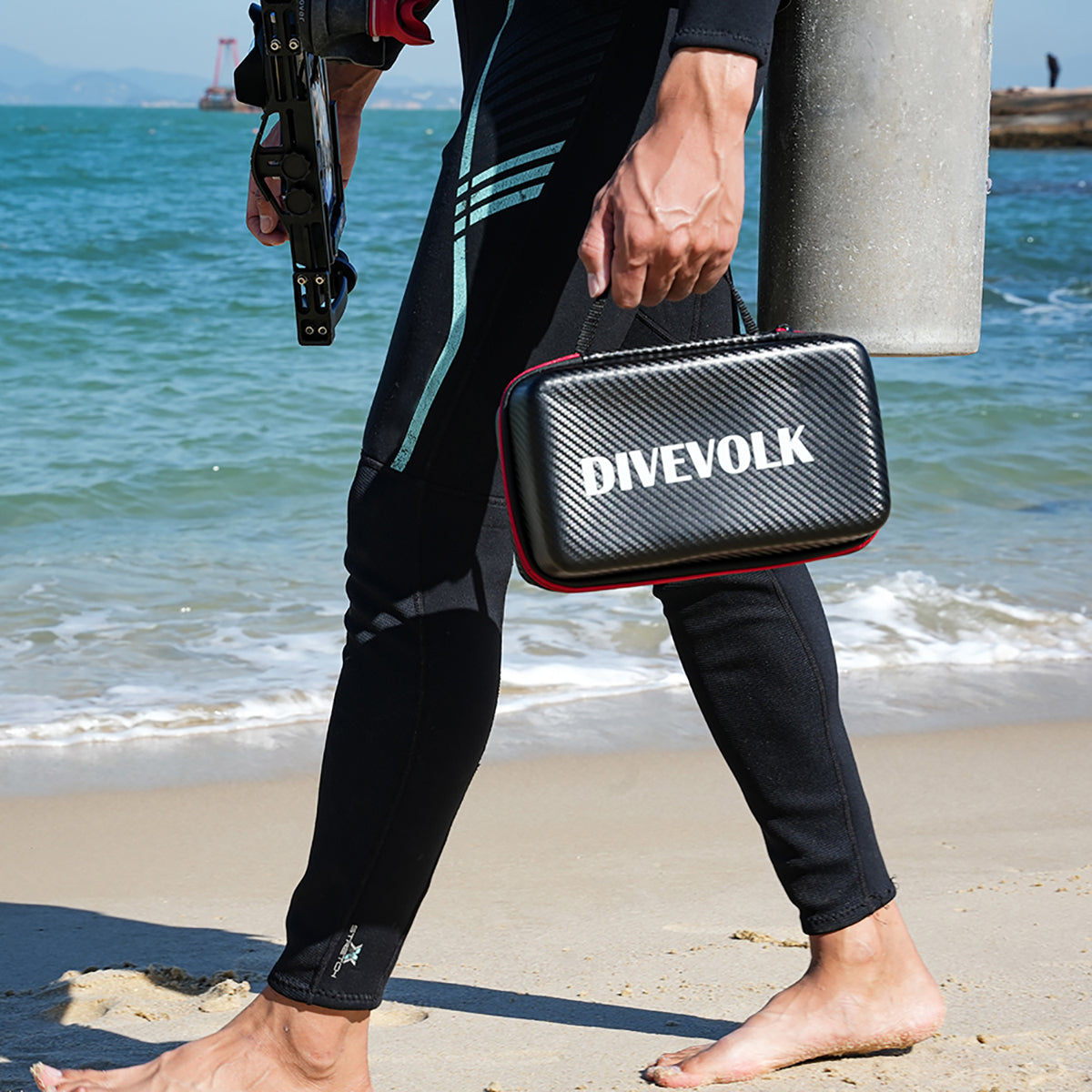
- Underwater phone housing — the SeaTouch 4 Max kit includes housing, lanyard, and carrying case
- Your phone (fully updated, airplane mode enabled, storage cleared)
- Silicone grease for the housing's sealing gasket (check the seal before every dive day)
Lenses (pick based on destination):
- Wide-angle lens — for reef scenics, large animals, wrecks, and cenote caverns
- Macro lens — for nudibranchs, pygmy seahorses, coral detail, and blackwater subjects
Lighting:
- Video light — essential below 10 meters and in any cavern or wreck environment. A 2000+ lumen light is the minimum for useful color restoration
- Backup light — small, cheap, reliable. Clip it to your BCD
Support:
- Tray and handle system for stable two-handed shooting
- Lanyard — always. Dropping a housing at 30 meters is a $500+ lesson
- Microfiber cloth and freshwater rinse bottle for surface intervals
- Dry bag for boat transfers
On your phone:
- Camera app configured before the trip (resolution, format, grid overlay)
- At least 50 GB free storage — 4K video eats space fast
- Offline backup solution (portable SSD or laptop) for daily transfers
For a more detailed breakdown of phone-based underwater photography technique, our complete guide to underwater smartphone photography covers everything from camera settings to composition principles.
The ocean doesn't care what camera you're holding. It cares whether you're in the right place at the right time, with enough skill to stay calm and enough preparation to capture what's in front of you. Pick your destination carefully, plan around the season, and bring the right lens. The rest is just diving.
Explore more destination guides and photography tips on NOAA's Ocean Explorer for marine science context, and the Cousteau Foundation for conservation-first diving perspectives.