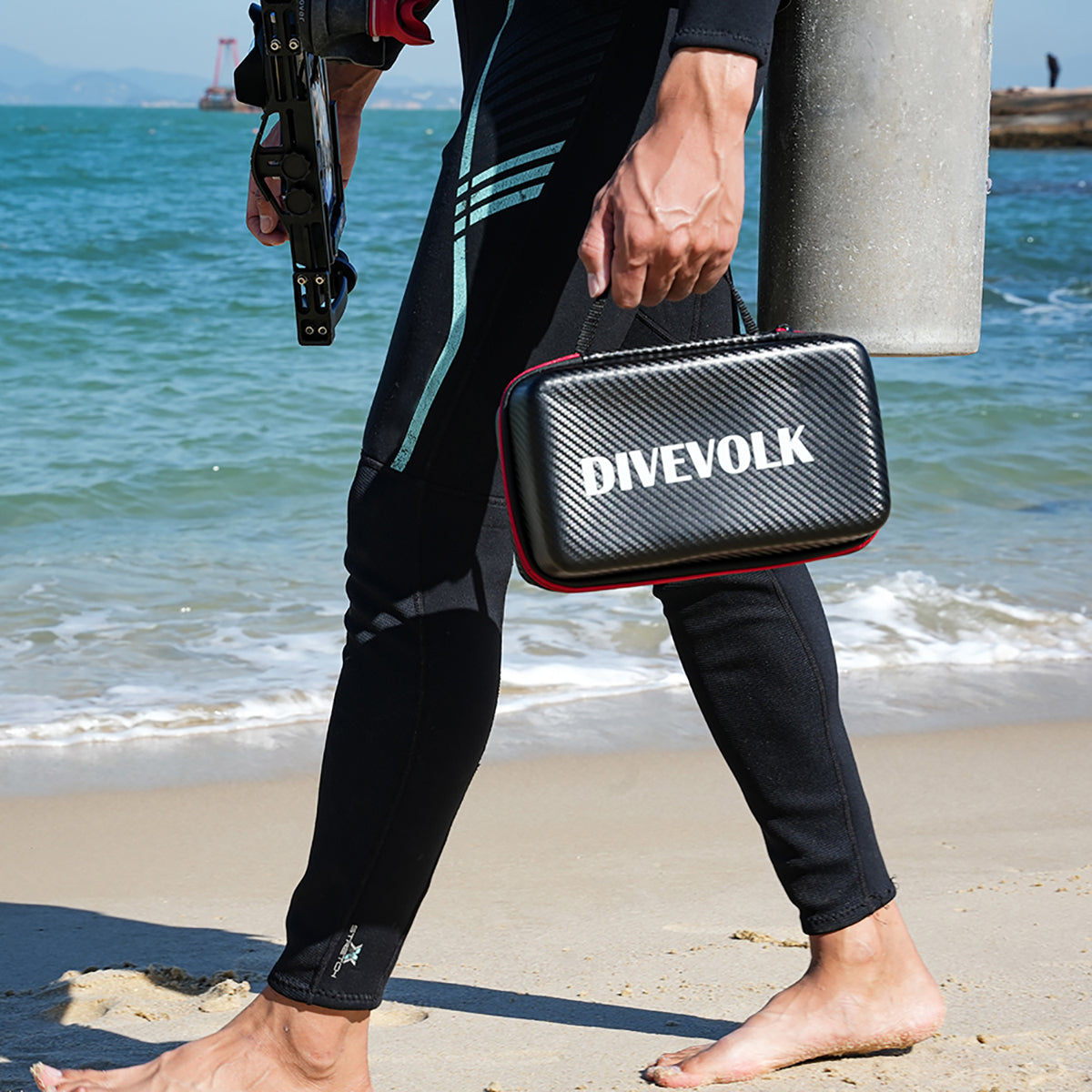

The SeaTouch 6 Pro is DIVEVOLK's sixth generation of the flexible touchscreen housing that lets a diver run a phone underwater with bare fingers, using the phone's own camera app and its own screen. This article is an overview of what the company has published about the housing, written for divers who are deciding whether to pay attention to it. Where a number comes from DIVEVOLK's product documentation, it is stated as such. Where a claim needs water time to mean anything, that is said too.
The Short Version
The SeaTouch 6 Pro is IPX8 rated to 60 meters, has no buttons at all, and is built around a new touchscreen membrane rated to 150,000 swipes instead of the previous 100,000. It takes phones up to 18 mm thick instead of 15 mm. A snorkeling red filter and an anti-fog desiccant pad come in the box, which is new for the line. The dome port now mounts to an integrated slot with no adapter and covers the main and ultra-wide cameras at the same time. The external shutter can be mounted on either side. On land it weighs 475 g; in the water with an iPhone 16 Pro Max inside it comes in around 150 g, close to neutral.
Those are the six changes DIVEVOLK put its name behind. Everything below explains what each one does on a dive, and where a full underwater test still has work to do.
The Sixth-Generation Membrane and the Swipe-Up Problem
The membrane is the whole product. Finger pressure passes through the film to the phone's capacitive screen, so tap-to-focus, pinch-to-zoom, lens switching and mode changes work at depth exactly as they do on land. No companion app, no pairing step, nothing to configure before you get wet.

The sixth generation uses a new material and a new multi-layer assembly process, and the swipe endurance standard rises from 100,000 cycles to 150,000. That number is a bench standard from DIVEVOLK's own testing, not a warranty period, and it is worth reading as a durability target rather than a promise about your specific unit.
The more interesting change is the touch window. On the SeaTouch 4 Max, owners of large phones could not swipe up from the bottom edge to get back to the home screen, and the practical workaround was AssistiveTouch: an on-screen button that stood in for the gesture the membrane could not reach. The SeaTouch 6 Pro widens the window so the native swipe-up works directly and touches near the screen edges register more easily. DIVEVOLK also says newer phones no longer need their screen protector peeled off before going in, which removes an annoying step for anyone who has just paid for a fresh protector. If you have fought with edge gestures on an older housing, our SeaTouch 4 Max touchscreen troubleshooting guide describes the behavior this generation is trying to fix.
How You Actually Control It
The SeaTouch 6 Pro is a button-free housing, and this matters more than it sounds. Once the phone is sealed inside, its volume keys, power button and side button cannot be pressed, so every input goes through your finger, the membrane, and the phone's own screen. Two consequences follow. First, any native "underwater mode" that switches the phone to hardware-key control has to be left off, because it disables the touchscreen the housing depends on. Check that setting before you seal up. Second, if you want a physical click, especially in gloves, the answer is the DIVEVOLK Underwater External Shutter, a Bluetooth 5.4 trigger rated to 60 meters and tested past 100,000 presses. We covered how it works in our external shutter overview.
The SeaTouch 6 Pro gives that shutter two mounting positions instead of one, so it lands under the thumb whether you shoot left- or right-handed, and the inverted position drops the lens closer to the seabed for low-angle macro. Anyone who has tried to hold a rig at 30 degrees with the trigger on the wrong side will recognize why this was on the list.
Red Filter in the Box
Sea water strips red light out of the spectrum within the first few meters, which is why unfiltered shallow shots come back blue and flat. NOAA's National Ocean Service explains the absorption order plainly. The SeaTouch 6 Pro ships with a snorkeling red filter tuned for 0 to 10 meters that clips straight onto the lens window with no bracket and no threaded adapter, which makes it usable on a snorkel trip where you would never bother assembling a clamp.
Deeper work still wants a different tool. DIVEVOLK's Internal Red Filter, which clips inside the wide-angle lens barrel rather than stacking on top of it, is tuned for 5 to 25 meters. Filters and video lights solve different halves of the same problem, and our guide on why colors fade underwater covers when to reach for each.
Fog, Seals and the Pre-Dive Routine
A built-in desiccant pad slot is new. Pads swap in seconds without tools and come with the housing, which matters on a boat where the gear bag has been baking in the sun and the water is 12 degrees cooler than the deck. Fogged lens glass has ruined more dives than leaks have.
Sealing is three layers of precision seals with a minimal seal-cover design and no button openings, and DIVEVOLK states no vacuum pump is needed before entry. The body is impact-resistant engineering plastic with aluminum alloy protective frames at the touchscreen edge and behind the lens glass, plus 316 stainless steel hardware. Whatever the housing is made of, the seal still depends on you: rinse, dry, inspect and store it properly, and follow the maintenance rhythm Divers Alert Network recommends for any pressure-bearing dive equipment. Our post-dive cleaning steps spell out the five minutes that decide how long a housing lasts.
18 mm of Clearance, and Why It Was Needed
The internal envelope grows from 15 mm to 18 mm, and the housing accepts phones up to 180.0 × 82.5 × 11.2 mm with a camera bump as tall as 17 mm. DIVEVOLK lists every iPhone through the iPhone 17 Pro Max, the Samsung Galaxy S26 Ultra, and thick-module Android flagships such as the vivo X300 Ultra and Xiaomi 17 Ultra as fitting inside that envelope, with mainstream Huawei, Google, OnePlus and OPPO models on the compatibility list.
Camera modules have grown faster than housings for three years running, and a 15 mm ceiling was starting to exclude exactly the phones that shoot best. Before you buy for a specific model, measure yours, including the case if you plan to leave one on, and check the current compatibility list through technical support rather than assuming. Phones released after this announcement are not covered by anything published so far.
Dome Port and Split Shots
The housing has an integrated dome port mounting slot, so the second-generation Dome Lens attaches with no extra adapter. The window is larger than the previous version and covers the main and ultra-wide cameras at once, which means you can switch phone lenses mid-dive without unclamping and repositioning the dome. The AquaLock structure sets with one click and holds a steady waterline between the dome and the housing glass. If split shots are why you are reading this, our dome port technique guide is the practical companion, and the rest of the optics live in lenses and filters.

At the Surface
GPS and cellular signals pass through the plastic body, so at the surface, without opening anything, you can check position, navigate back to the boat, or make a call. Divers have used this in earnest. A diver named John, who told his story at SCUBA SHOW 2026, used a phone kept dry in a DIVEVOLK housing to reach his family from the surface after strong current pushed him and his wife offshore near Saba, and that call set a rescue in motion. We published his account in full: read what happened off Saba. Underwater is a different matter, since radio does not travel through water; live connectivity at depth is the job of the SeaLink Underwater Smartphone Data Transmitter.

What a Full Underwater Test Still Has to Show
Everything above comes from DIVEVOLK's published documentation. A serious in-water review still owes readers several things that no spec sheet can settle: how the wider touch window feels on a large Android phone after a week of salt and sand, whether the 0 to 10 m red filter holds up in green temperate water as well as it does in tropical blue, how long a desiccant pad actually keeps the glass clear across a two-tank day with a big temperature swing, whether the dome's waterline stays clean when a swell is running, and how the 475 g body trims out once a clamp, a lens and two lights are hanging off it. Buoyancy and task loading are where camera divers get into trouble, a point Divers Alert Network makes repeatedly. We will publish our own in-water piece once we have dives behind us rather than a press kit.
Two ground rules stay the same whatever the gear does. Depth ratings are engineering limits, not dive plans, and pressure rises by about one atmosphere every 10 meters, as NOAA notes. And no photograph is worth touching. Keep your distance from coral and animals, control your buoyancy first and frame second, in line with Florida Keys National Marine Sanctuary guidance for responsible diving.
Where It Sits in the Line
The SeaTouch 4 Max series stays in service and remains a strong housing; the generation-by-generation differences are laid out in our SeaTouch 4 comparison guide and in the launch note for the SeaTouch 4 Max Platinum V2. Kit contents, regional availability and pricing for the SeaTouch 6 Pro follow the official launch, so check the housing collection for the current configuration rather than trusting a number from a rumor thread.