
One of the biggest frustrations of diving is something most divers stop noticing: the moment you drop below the surface, the radio world disappears. Water swallows the wavelengths we use to talk, text, stream, and look things up. You can be ten feet underwater right next to a cell tower and it makes no difference. The signal simply does not survive the trip.
That is the problem Scuba Diver Magazine put to the test in a recent unboxing and review of the DIVEVOLK SeaLink underwater smartphone data transmitter — the contact-type WiFi bridge that lets a phone in an underwater housing behave as if it were still on land. The verdict, delivered at the end of a careful walkthrough of the whole kit, is that SeaLink is "a pretty remarkable piece of kit" that "really bridges that gap between the surface and the depths."
What Scuba Diver Magazine Actually Tested
The review is not a marketing reel. It is a full hardware walkthrough — every cradle, every seal, every latch — filmed by a reviewer who spends his professional life opening dive gear on camera. That is what makes it useful. You can see the retractable tether, feel the ratchet of the spool through the lens, and watch the outrigger floats unfold into a stable surface platform.
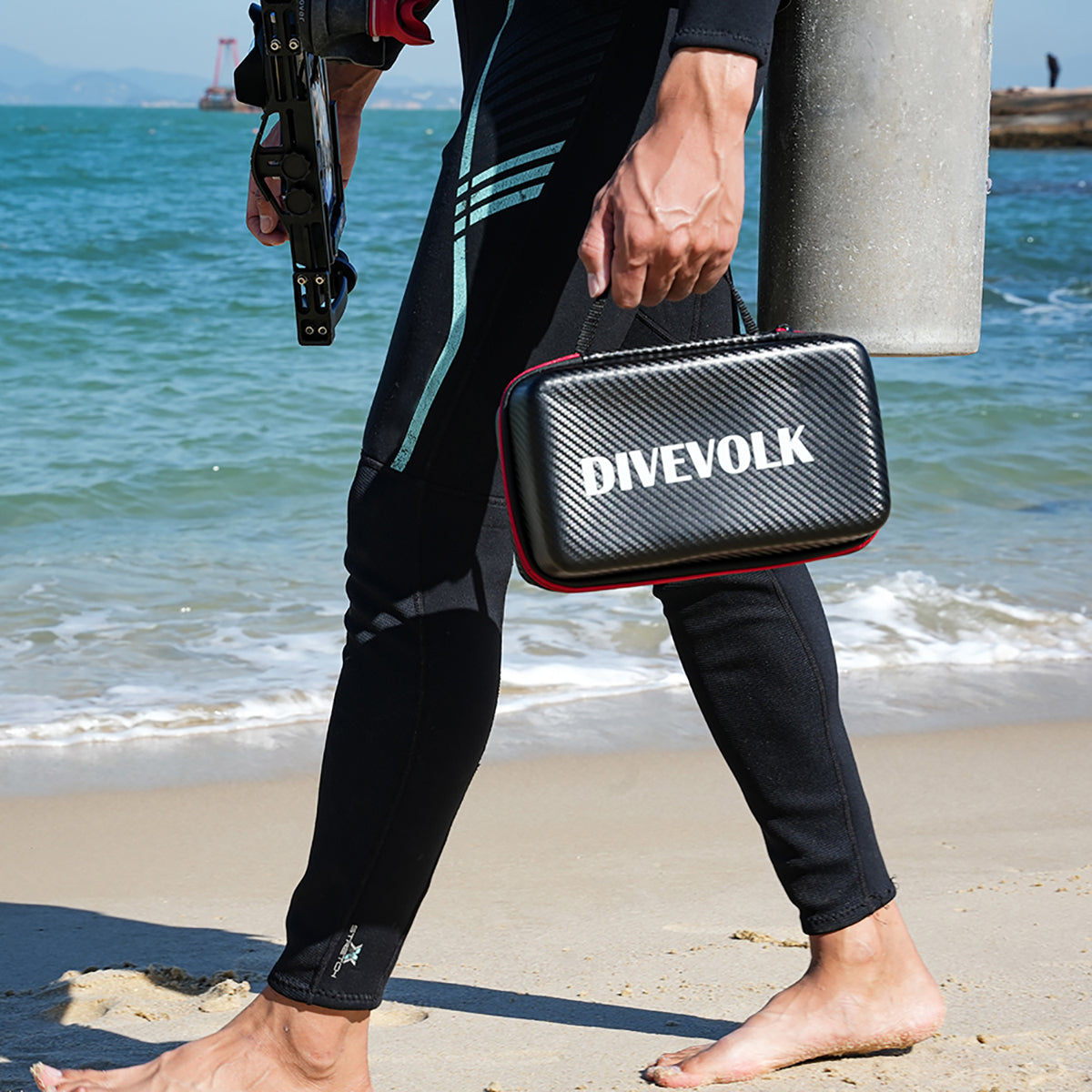
The unit arrived in what the reviewer describes as a "big rigid case" with a proper locking mechanism, a mesh drying bag, a protective cover for the housing, cradles for different phone models, a USB-C recharging dock, spare seals, tools, and — tucked inside — the pair of items that do the actual work: the underwater handset and the floating surface transmitter, joined by a coiled tether.

Fully kitted, it is a substantial piece of equipment. The reviewer puts the case at 59 × 39 × 16 cm and the total packed weight at roughly 9.12 kg. The handset itself is about -360 g negatively buoyant in salt water before you add lighting or lens accessories, which is exactly what you want from a housing that needs to stay put when your hands are busy.
The Handset: A SeaTouch With a Mission
If you already know DIVEVOLK's SeaTouch underwater phone housings, the SeaLink handset will look familiar. The top-opening door uses the same double-screw locking mechanism and large sealing gasket. Inside, a plastic cradle holds the phone in a defined position, and DIVEVOLK manufactures those cradles themselves — including, as the reviewer notes, custom 3D-printed inserts for unusual phone models. Critical components are 316 stainless steel for corrosion resistance, and the 82 × 60 mm screen window is sized generously enough to accommodate the wandering camera placements that modern smartphones keep inflicting on us.
The phone-size window is finite: up to 180 × 82.5 × 11.2 mm, with a camera bump no thicker than 15 mm. Anything beyond that, the reviewer suggests, and you should message DIVEVOLK before you order.

Two things separate this handset from a standard SeaTouch. The first is the pair of dual grips designed for vertical shooting — unusual for still photographers, but natural for anyone filming a livestream or a piece-to-camera, and ergonomic for one-handed operation when the other hand is working the phone screen. The second is the tether spool on the front, with a one-way ratchet that lets line pay out under a trigger and winds back in cleanly without feeding itself out to tangle. The reviewer calls out the detail: a small rubberized guide holds the cable in place so it cannot drift loose on the descent.
The Touchscreen That Works Underwater
The part that usually stops cheaper housings — and the part the Scuba Diver Magazine reviewer lingers on — is the touchscreen itself. Capacitive touch does not travel through glass and neoprene the way it travels through your thumb. DIVEVOLK's answer is a dual-film membrane on the diver-facing side: a hard inner layer, a stretchable outer layer, and a non-compressible fluid sealed between them. You push through the squidgy feel and your fingertip reaches the phone's actual screen. It is pressure-tested and scratch-tested to 100,000 cycles.
"It's effectively a touchscreen, but with that fluid in the middle… It's got that squidgy consistency that you do have to push through to activate the touchscreen on your phone. But it does work."

DIVEVOLK recommends removing thick screen protectors for best response and suggests enabling the phone's built-in touch-accessibility options, which is a pragmatic note most reviews of phone housings skip entirely.
Then there is a detail the reviewer singles out that most divers will never see: a pressure-balance mechanism built into the grip. The fluid in the touchscreen is not compressible, but the air space inside the housing is — and it needs to equalize on the way down. DIVEVOLK engineered that compensation into the hardware so the housing stays balanced through the descent and ascent, which is the kind of quiet engineering that keeps a seal intact for a hundred dives instead of five.
The Surface Unit: 30 m of Tether, 5 kg of Pull
The floating transmitter is where the magic actually happens. It is built around a core electronics pod — SIM card tray, antenna on a bayonet twist-lock, and four 21700 lithium-ion rechargeable batteries. The reviewer reports up to 60 hours of runtime on the full four-cell pack, with the option to run on two cells and halve the time for shorter dives.

The dual outrigger floats collapse for transport and then unroll into soft rubber bladders that you fill by pulling on the slide to suck air in, much like a dry-bag vacuum. A bright orange diver-down sock slips over the central pod so a boat driver can actually find you from a distance — a small surface-signalling nod that matters when you are streaming live and drifting with current.
The tether is 30 m of cable on the spool, protected by a bungee on the surface end to absorb yank when chop moves the float, and rated to a 5 kg tension limit. The reviewer is careful with the depth claim, and so are we: in a pool you might reach a true 30 m below the float, but in open water, current will bow the cable diagonally and shorten your actual vertical reach. Plan your dive profile with that in mind.
"Just remember, if there's any kind of water movement, that wire will start to bow. The longer it is and the surface unit is going to start to move. So that wire is going to go diagonal in the water and you won't be able to actually reach that 30 m of depth."
Setup: Two Minutes, Then You're Online
Scuba Diver Magazine clocks field setup at "a minute or two." Open the surface unit, drop the SIM into the tray, twist the antenna on, load the batteries into the attached carrier so they cannot escape over the side of the boat, close the door. Press the power switch. The transmitter broadcasts a WiFi network; your phone pairs to it from inside the housing and uses your own mobile plan as if you were standing on the beach. Load the phone into the cradle, tighten the two locking screws, and the system is live.

From that moment, the phone behaves like a phone. Livestream to YouTube or a conservation audience. Jump on a video call with a researcher ashore. Pull up an ID key when you see a fish you do not recognise. Check a dive log. Answer an email on the safety stop if you really want to. The reviewer's deadpan delivery — "if you got nothing better to do" — is the tell that he knows most of us will pick livestreaming over inbox triage, but the point stands: the surface does not end at the waterline anymore.
Who This Is Actually For
The Scuba Diver Magazine review is disciplined enough to close with the right caveat: SeaLink is not something every diver needs. A recreational diver on a weekend reef trip does not need a mobile data link to enjoy the dive. But for a specific set of users, the device does something nothing else does.
"It's not something that every diver will need, but if you're into underwater research, live streaming or documenting your dives in real time, this really does open up a new world of possibilities."
That list — research, livestreaming, real-time documentation — maps cleanly to the use cases we have seen in the field. Earlier this year, Argentine journalist Gastón Flageat used SeaLink to complete the first live underwater TV broadcast on Canal 26, talking to studio anchors in Buenos Aires while submerged in a dive tank in Germany. Reef surveyors have started using it to show shore-based scientists exactly what is on the substrate in real time, rather than debriefing from memory hours later. Dive educators use it for split-screen teaching. A dive operator can show a nervous partner at the surface that their diver is fine, right now, no waiting.
The review's emphasis on robustness — heavy case, 316 stainless steel fittings, attached battery carriers so nothing drops overboard, bungee on the tether so nothing snaps under load — is the reason the system graduates from novelty to working tool. The SeaLink hardware is designed to survive the repeated, ugly reality of boat decks and surge, not just a calm swim test.
The Verdict
Scuba Diver Magazine's review lands where careful gear reviews usually land: not at "everyone needs this," but at "this does the job it claims to do, and it does it well." The unboxing walkthrough is worth watching in full if you are weighing the purchase — the small engineering details are the ones that decide whether a piece of dive kit survives a season or not, and the review surfaces the ones that matter.
For divers whose work or storytelling depends on the surface knowing what they are seeing, SeaLink is the first consumer-grade tool that makes real-time underwater connectivity genuinely practical. For everyone else, it is a glimpse of where the category is heading.
You can explore the full SeaLink Transmitter collection or the broader range of DIVEVOLK underwater phone housings to see which configuration fits your phone and your workflow. Watch more gear reviews on the Scuba Diver Magazine YouTube channel, and follow their ongoing coverage at divenet.com.