
Scuba diving is supposed to be the ultimate escape — weightless, quiet, and meditative. Yet talk to any diver with a few hundred logged dives and you'll hear a familiar list of complaints: a shoulder that clicks every time they reach overhead, a neck that locks up after a two-tank morning, knees that ache on the walk back to the car. These aren't badges of honor. They're preventable injuries that, left unchecked, can shorten your diving career by years.
The good news? Diving injury prevention doesn't require a gym membership or a sports-medicine degree. It requires understanding why these injuries happen in the first place — and making a handful of changes to your warm-up routine, your in-water technique, and your gear choices. This guide covers all three.
Why Divers Get Hurt: The Real Causes of Shoulder, Neck, and Knee Pain
Most dive injuries aren't dramatic. They're the slow, cumulative result of repeating the same awkward movements dive after dive. Here's what's actually going on in the three most vulnerable areas.
Shoulder Injuries
Your shoulders do more heavy lifting in diving than almost any other joint. Scuba diving shoulder pain typically comes from one or more of these culprits:
- Repetitive tank lifting. A standard aluminum 80 weighs about 31 pounds (14 kg). Swing that onto your back twice a day, five days in a row on a dive trip, and you've essentially done 10 sets of an awkward overhead press — often with poor form and a rocking boat under your feet.
- Climbing boat ladders under load. Reaching overhead to grab a ladder rung while wearing 40+ pounds of gear puts your rotator cuff in its most vulnerable position.
- Poorly fitting BCDs. A BCD that rides too low or has loose shoulder straps shifts weight unevenly, forcing one shoulder to compensate for the other throughout the dive.
- Giant stride entries with unsecured arms. If your arms aren't locked against your mask and regulator during a giant stride, the impact can jolt your shoulder joint hard enough to strain the surrounding tendons.

Neck Injuries
The neck is especially vulnerable because it's the one joint that never gets a break underwater. Common triggers include:
- Heavy camera rigs. A DSLR in an underwater housing with dual strobes can weigh over 10 pounds (4.5 kg) in water. Hold that at arm's length for 60 minutes and your neck and trapezius muscles pay the price.
- Constant upward gaze. Newer divers tend to crane their necks upward, fighting their natural trim position. Over a week-long trip, this can produce severe cervical strain.
- Tight wetsuit hoods. A hood that's too small compresses the neck muscles and restricts blood flow, accelerating fatigue and stiffness.
- Carrying gear bags on one shoulder. That lopsided walk from the car to the boat — repeated over hundreds of dive days — creates chronic imbalances in the neck and upper back.
Knee Injuries
Knees absorb more shock on dive days than most people realize. Diving knee injury risk increases with:
- Stiff-ankle flutter kicks. When ankles don't flex freely, the force of each kick transfers straight up to the knee joint. Over a 60-minute dive with hundreds of kicks, that's significant cumulative stress.
- Walking in fins and heavy gear. Shuffling across a boat deck or dock in full gear — especially with fins on — creates an unnatural gait that loads the knees at odd angles.
- Kneeling on rocks during shore entries. Without knee protection, rough surfaces cause both acute bruising and long-term cartilage wear.
- Zodiac tenders. Climbing in and out of inflatable boats from a low waterline requires deep knee bends under load — exactly the movement orthopedic surgeons warn about.
Pre-Dive Warm-Up: 5 Minutes That Prevent 5 Months of Pain
A proper dive warm-up takes less time than setting up your gear and dramatically reduces injury risk. Do these exercises on the boat or beach before gearing up.

Shoulders (2 Minutes)
- Arm circles: 15 forward, 15 backward, starting small and increasing the radius. This warms the rotator cuff and lubricates the joint.
- Cross-body shoulder stretch: Pull each arm across your chest and hold for 15 seconds. Targets the posterior deltoid and infraspinatus — the muscles most stressed by tank lifting.
- Band pull-aparts (if you travel with a resistance band): 15 reps at chest height to activate the rear deltoids and rhomboids.
Neck (1 Minute)
- Slow neck rolls: 5 clockwise, 5 counter-clockwise. Keep the movement smooth — never force it.
- Chin tucks: 10 reps. Pull your chin straight back (creating a "double chin") and hold for 2 seconds. This activates the deep cervical flexors that stabilize your neck underwater.
Knees and Lower Body (2 Minutes)
- Knee circles: Feet together, hands on knees, circle 10 times each direction. Warms the synovial fluid in the joint.
- Standing quad stretch: Hold each foot behind you for 20 seconds. Tight quads pull on the kneecap and increase patellofemoral pain.
- Bodyweight squats: 10 slow, controlled reps to full depth. Activates the glutes, quads, and hamstrings that protect the knee during heavy-load movements.
- Ankle circles: 10 each direction. Flexible ankles mean your fins do the work — not your knees.
Core Activation (1 Minute)
- Plank: 30 seconds. A strong core keeps your spine neutral during gear-up and in-water maneuvering.
- Dead bugs: 8 reps per side. Lying on your back, extend opposite arm and leg while keeping your lower back flat. This trains the exact anti-rotation stability you need for proper trim.
In-Water Technique: Small Fixes, Big Results
The way you move underwater has more impact on injury prevention than any exercise. Refine these five areas and you'll notice the difference within a few dives.
Trim Is Everything
A properly horizontal body position — what instructors call "good trim" — is the single most important factor in diver fitness and joint health. When your body is horizontal, your neck sits in a neutral position (you look ahead by moving your eyes, not cranking your head up). Your kicks propel you forward instead of upward, reducing wasted effort and knee stress. PADI's training materials emphasize trim as the foundation of efficient diving — and they're right. Research published by the National Institutes of Health has documented the link between poor buoyancy control and increased musculoskeletal strain in recreational divers.
Frog Kick vs. Flutter Kick
The flutter kick is intuitive but hard on knees, especially if your ankles are stiff. The frog kick uses a wider, more rotational leg movement that distributes force across the hip and thigh rather than concentrating it at the knee. It's also more efficient, producing more thrust per calorie. If you're experiencing knee pain, switching to a frog kick — or at least alternating between the two — can make a measurable difference.
Camera Rig Management
If you shoot underwater, your camera setup is likely the single biggest contributor to neck and shoulder strain. The fix isn't to stop shooting — it's to manage the weight intelligently:
- Use a bolt snap or retractor clip to secure the rig to your BCD when you're not actively shooting. This takes the load off your arms and neck during transits.
- Keep arms close to your body. Extended arms act as a lever that multiplies the effective weight your shoulders and neck have to support.
- Consider whether you actually need the full DSLR rig. Modern underwater phone housings like the SeaTouch 4 Max deliver impressive image quality at a fraction of the weight and bulk — a topic we'll revisit in the gear section below.

BCD Fit and Weight Distribution
An ill-fitting BCD is a silent injury machine. The shoulder straps should sit snugly without digging in. The cummerbund should be tight enough to prevent the BCD from riding up but loose enough to breathe comfortably. Distribute your weight evenly — consider trim weights on the tank band or cam strap to shift load off the shoulders and onto the hips.
Entries and Exits
Technique matters more than strength here. For giant strides, secure your mask and regulator with one hand, hold the other arm across your weight belt, and step out — don't jump. For boat ladder exits, let the ladder do the work: keep your arms straight, step up one rung at a time, and if the boat crew offers to take your gear in the water, let them. There's no trophy for climbing a ladder with a full rig.
Already in Pain? Recovery Guidance for Divers
If you're reading this with an ice pack on your shoulder, here's what to do — and when to escalate.
The RICE Protocol
Rest, Ice, Compression, Elevation remains the first-line treatment for acute musculoskeletal injuries. For dive-related strains, ice the affected area for 15-20 minutes every 2-3 hours for the first 48 hours. Avoid heat during this initial phase — it increases inflammation.
When to See a Doctor
Self-management is appropriate for mild soreness that improves within 48-72 hours. See a sports medicine physician or orthopedic specialist if you experience:
- Sharp, stabbing pain (especially in the shoulder) during specific movements
- Numbness or tingling in your arms or legs
- Swelling that doesn't subside within 3 days
- Pain that wakes you up at night
- Any joint that feels unstable or "gives way"
The Divers Alert Network (DAN) maintains a global network of dive medicine specialists and offers a 24/7 medical hotline. If your injury occurred during or immediately after a dive, DAN should be your first call — some musculoskeletal symptoms can overlap with decompression illness, and only a trained dive physician can rule that out. Once a physician has cleared you, a structured physical therapy and stretching routine helps you rebuild before the next trip.
Between-Dive Recovery
- Gentle stretching during surface intervals keeps muscles from tightening up. Focus on the areas that were under load.
- Foam rolling (a travel-sized roller fits in most dive bags) targets the thoracic spine, quads, and IT band — all common trouble spots for divers.
- Anti-inflammatory nutrition: Omega-3s, turmeric, and adequate hydration all help manage inflammation. On multi-day dive trips, what you eat between dives matters.
Equipment Modifications
Sometimes the smartest recovery strategy is changing your setup rather than toughing it out:
- Switch to a lighter travel BCD (many weigh under 5 pounds)
- Use a wheeled gear bag or cart to eliminate shoulder-carry strain
- Replace heavy traditional straps with padded, ergonomic alternatives
- Downsize your camera rig (more on this below)
Gear Choices That Reduce Injury Risk
The right equipment doesn't just perform better underwater — it protects your body on the surface. Here are the highest-impact gear swaps for injury prevention.
Travel BCDs
A modern travel BCD weighs 4-6 pounds compared to 8-12 for a traditional jacket-style BCD. Over a week of diving, that difference translates to hundreds of pounds less cumulative load on your shoulders and back. Look for models with integrated weight systems that shift mass from shoulders to hips.
Split Fins
Split fins require significantly less effort per kick cycle than paddle fins. For divers with existing knee issues — or those looking to prevent them — the reduction in resistance translates directly to less joint stress. They're particularly effective for flutter-kick-dominant divers who aren't ready to switch to a full frog kick.
Phone Housing Instead of DSLR Rig
This is the single biggest weight-and-bulk reduction available to underwater photographers, and it's the one most divers overlook. A full DSLR underwater setup — camera body, housing, port, dual strobes, arms, clamps, and tray — can easily top 12-15 pounds (5.5-7 kg) on land and remain awkwardly bulky underwater. That mass, held at arm's length, creates enormous leverage on your shoulders, neck, and wrists.
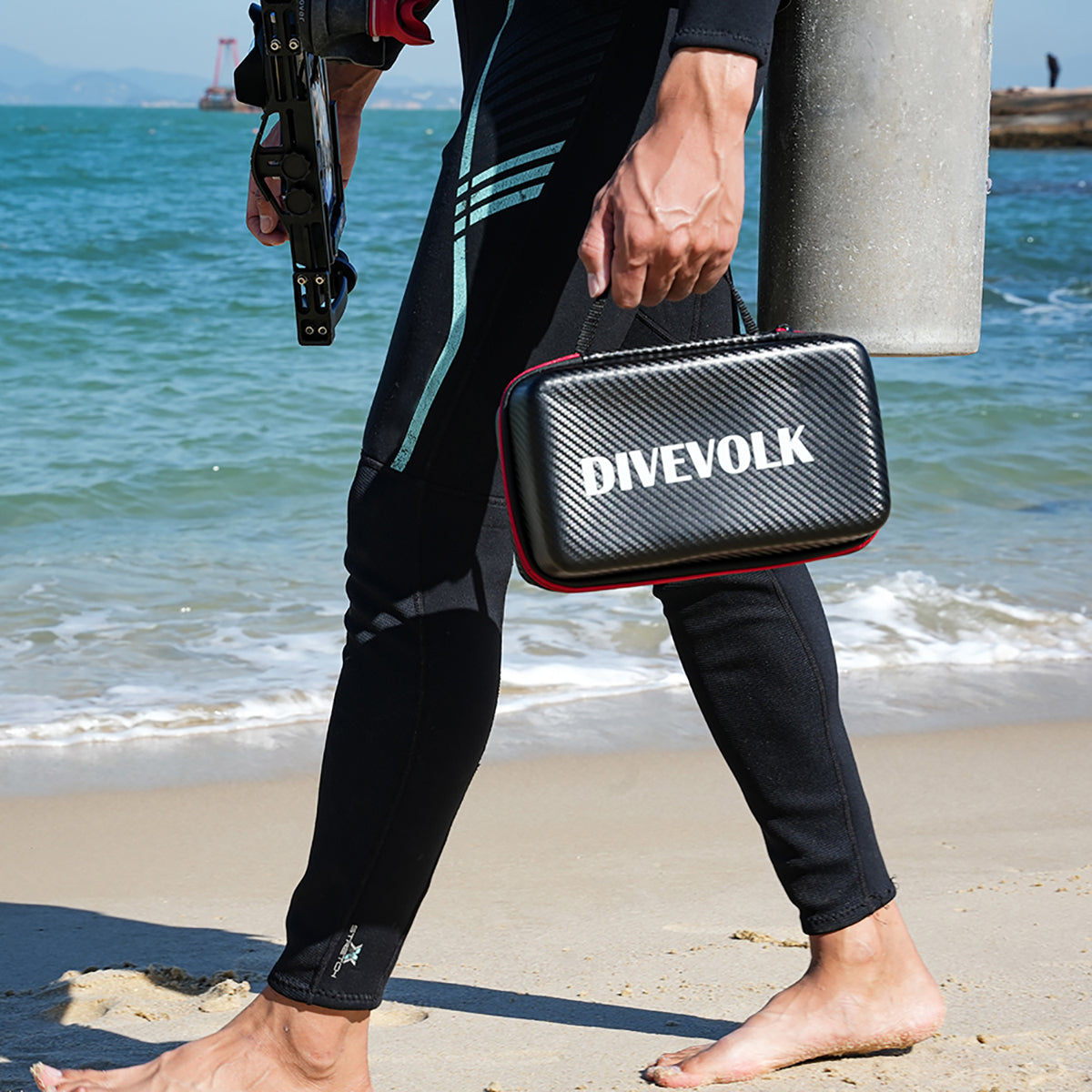
A SeaTouch 4 Max Kit from DIVEVOLK replaces all of that with a compact, lightweight system that fits in your BCD pocket between shots. Pair it with a compact dive light and a macro or wide-angle lens attachment, and you have a capable photo and video system that weighs a fraction of the DSLR alternative. Your shoulders and neck will notice the difference on the first dive — and the gap widens over a full week of diving.
For divers recovering from shoulder or neck injuries, switching to a phone housing often means the difference between sitting out the photo dives and participating fully. Check DIVEVOLK's technical support page for setup guides and compatibility information.

Wheeled Gear Transport
A gear cart or rolling dive bag eliminates the shoulder and knee strain of carrying equipment across parking lots, docks, and beaches. It's a small investment that pays dividends on every dive trip — especially for divers over 40 or those with existing joint issues.
The Long Game: Dive for Decades, Not Just Years
Diving is a lifelong sport — but only if your body can keep up. The divers who are still exploring reefs in their 60s and 70s aren't necessarily the fittest. They're the ones who respected their joints early, built smart warm-up habits, refined their technique instead of muscling through it, and chose gear that works with their bodies instead of against them.
Start with the five-minute warm-up. Work on your trim. Reconsider whether you really need to carry that much weight to and from the water. Small changes compound over hundreds of dives — and the payoff is a longer, more comfortable diving career.
Your body is your most important piece of dive equipment. Treat it like one.