
On the boat, every underwater photographer faces the same choice: wide angle for a turtle that might cruise past, or macro for a tiny creature hiding under a ledge. With most camera systems, that choice is final once you roll in, and half the time the reef turns up the opposite of what you rigged for.
The SeaTouch 6 Pro Dual-Lens Kit is built so you don't have to choose. It pairs the full-touchscreen SeaTouch 6 Pro housing with a wide-angle wet lens and a macro wet lens on the same rig, so you can switch between them underwater. To see how that works on a real reef, we asked DIVEVOLK ambassador William (Bill) Stanley, creator of Stanley Scuba, Sailing & Adventures, about his SeaTouch 6 Pro field test in the Florida Keys, where he dived with a wide-angle lens mounted above the housing and a macro lens below it.
What's in the SeaTouch 6 Pro Dual-Lens Kit
The kit includes:
- SeaTouch 6 Pro Full-Touchscreen Underwater Housing
- Expansion Clamp with 67mm Lens Adapter
- A second 67mm Lens Adapter
- Underwater Wide-angle Lens (DLW-02A)
- Macro Lens Pro +18
- Deep Dive Filter with 67mm thread
- Internal Red Filter for the wide-angle lens
- Snorkelling Filter
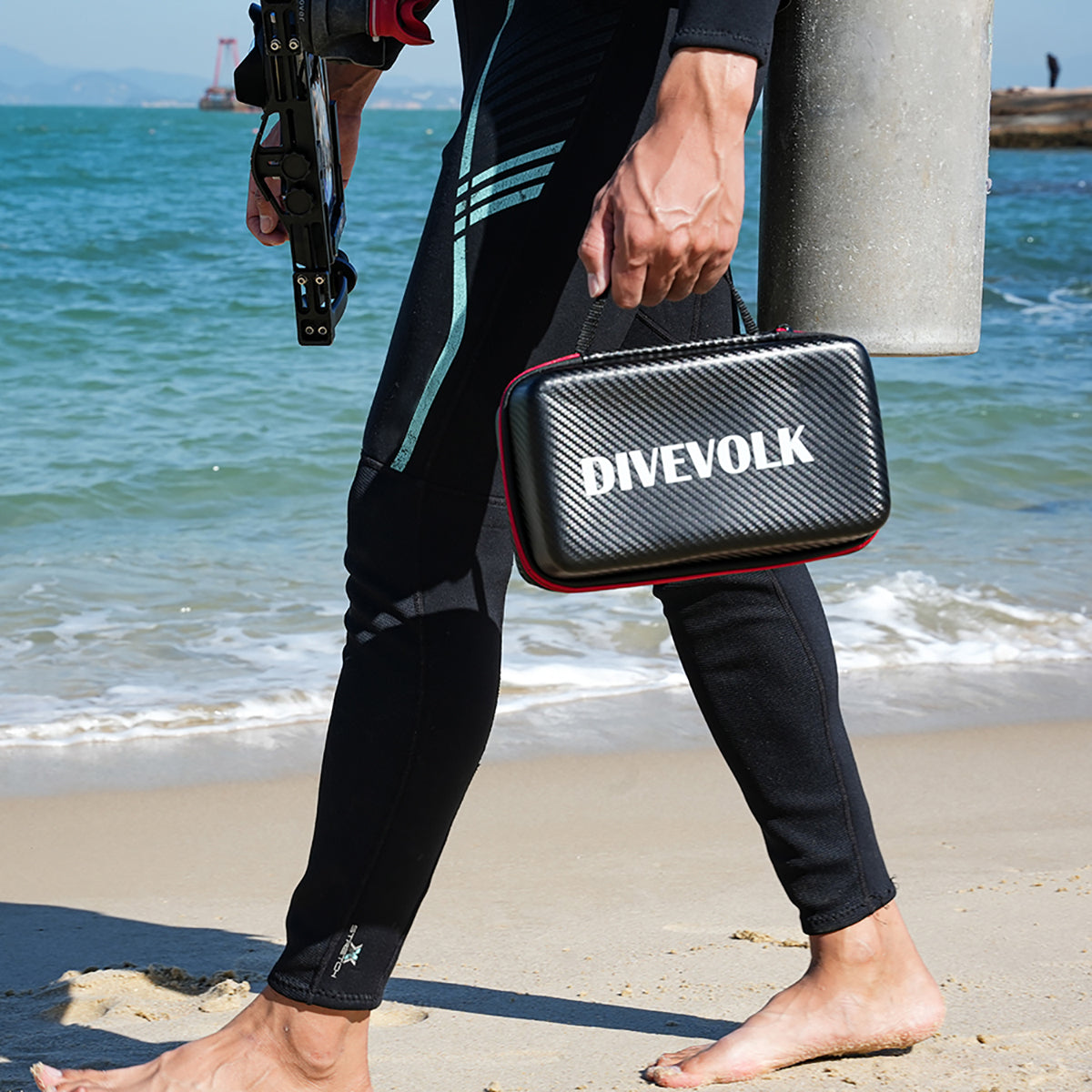
- Protective Cover, Outdoor Lanyard, and Travel Case

The three filters cover different depths:
- Snorkelling Filter (0–10 m): mounts directly on the housing's lens window and doesn't need the clamp.
- Internal Red Filter (5–25 m): snaps inside the wide-angle lens barrel, adding no distance in front of the lens.
- Deep Dive Filter (5–25 m): a 67mm red filter that screws onto the clamp's adapter ring.
The housing at the center of the kit is rated to 60 m (196 ft) and IPX8. Its sixth-generation touchscreen membrane is rated for 150,000 touches, and the housing weighs about 485 g on land. It fits phones up to 180.0 × 82.5 × 11.2 mm, with the phone no more than 17 mm thick at the camera module. When you order, you pick a phone-adapter option: iPhone 17/18 series (the iPhone 18 Duo is not compatible), iPhone 12 to 16 series (not mini), iPhone 12/13 mini, or another iPhone or Android model, which you name in full.
A handle tray, video lights, and an external shutter are not in the box; they are sold as separate add-ons.
How the Two Lenses Mount and Switch
The Expansion Clamp holds the two-lens setup together. It slides onto the housing and carries a 67mm lens adapter arm, and the second 67mm adapter in the kit gives you another lens position. That way the 0.6X wide-angle lens and the Macro Lens Pro +18 can both stay on the rig. You move whichever one you need in front of the phone's camera, or park both out of the way and shoot with the phone's native camera alone. The same clamp has dual 1/4" threads, M6 threaded holes, and a cold shoe mount, so you can add grips, trays, and lighting arms later.

If you are new to wet lenses, our guide to the DIVEVOLK 0.6X wide-angle lens covers how to frame with it.
Every camera control happens through the touchscreen. The SeaTouch 6 Pro is a button-free housing: once the phone is sealed inside, its volume, power, and side buttons cannot be pressed, so for a physical trigger you add the DIVEVOLK Underwater External Shutter. You tap to focus, swipe to adjust exposure, and change camera modes on the screen itself, and you can see what each lens captures in real time on the full display.
Bill Stanley's Florida Keys Field Test
Bill learned to scuba dive in 1983, when he was 13. Since then he has dived reefs and shipwrecks across the Caribbean, Mexico, the Galápagos Islands, and the United States. His favorite destinations include the Bahamas, Belize, the Cayman Islands, Turks and Caicos, Honduras, and the Dominican Republic. These days much of his filming takes place in the Florida Keys, and he also dives freshwater sites and submerged wrecks in the Midwest. He started Stanley Scuba, Sailing & Adventures to share those dives with people who might never see them in person, and he tests gear by diving with it: "Real diving conditions provide a much better understanding of equipment than specifications alone."
His earlier DIVEVOLK field test, with the SeaTouch 4 Max Plus Creator Kit, took him to the Crocker and Davy Crockett dive sites in the Florida Keys. He documented it in an unboxing and setup video and an underwater field test.

Bill on the boat during his earlier DIVEVOLK field test in the Florida Keys. Image courtesy of Stanley Scuba, Sailing & Adventures.
For the SeaTouch 6 Pro field test he used his iPhone 16 Pro Max in the housing, mounted on a DIVEVOLK dual handle tray with one SL50 video light. He made two dives at the Eagle Ray Alley and Sand Island sites on Molasses Reef, a Sanctuary Preservation Area in the Florida Keys National Marine Sanctuary.
Before every dive, Bill assembles and inspects the rig, checking that the housing, lenses, lighting, and controls are secure and comfortable to operate. "Once I'm underwater, I want the camera to feel natural in my hands so I can concentrate on the experience rather than the equipment," he says.

Bill on the dive boat with his SeaTouch 6 Pro rig, lens covers on. Image courtesy of Stanley Scuba, Sailing & Adventures.
His Setup Compared With the Retail Kit
Bill's rig and the retail kit share the key feature, two wet lenses on one housing, but they are not identical:
| Item | Bill's field-test rig | SeaTouch 6 Pro Dual-Lens Kit |
|---|---|---|
| Housing | SeaTouch 6 Pro | Included |
| Lens mounting | Expansion Clamp with two 67mm adapter arms (shown in his setup video) | Included: Expansion Clamp with 67mm Lens Adapter, plus a second 67mm Lens Adapter |
| Wide-angle lens | DIVEVOLK 0.6X wide-angle lens (DLW-02A) with the internal red filter | Included: DLW-02A and Internal Red Filter |
| Macro lens | DIVEVOLK +8 macro lens (engraved "Close-up Lens, Diopter +8") | Macro Lens Pro +18 (a stronger diopter) |
| Handle tray | DIVEVOLK dual handle tray | Not included |
| Lighting | One DIVEVOLK SL50 video light | Not included |
The macro lens is the main difference. The +8 gives more working distance, and the Pro +18 lets you get closer and fill the frame with smaller subjects. We compared the two in Macro Lens +8 vs. Pro +18, and both are listed under lenses and filters if you want to change the kit's macro strength.

Bill's assembled rig from his SeaTouch 6 Pro setup video. Image courtesy of Stanley Scuba, Sailing & Adventures.
Responding to the Dive Instead of Guessing It
Bill says flexibility was the biggest gain, and he explains it by comparing the setup with his Nikon system:
"When I use my Nikon underwater camera system, preparing for macro photography often means committing much of the dive to photographing smaller subjects. I've sometimes hesitated to do that because there's always the possibility that a turtle, shark, or other unexpected subject might appear."
With the SeaTouch 6 Pro rig, he doesn't have to make that call before the dive. "With the DIVEVOLK dual lens system, I can switch between the iPhone's native camera, the external wide angle lens, and the macro lens without returning to the surface. That freedom allows me to respond to whatever I encounter," he says. Carrying both lenses "has also encouraged me to spend more time practicing macro photography, something I continue to enjoy learning."
"I could move either lens into position underwater or swing both lenses out of the way and use the iPhone's native camera," he says. "Underwater conditions and subjects can change quickly, and having several photographic options available without returning to the surface makes the experience much more enjoyable."

Both wet lenses swung clear of the lens window, so the iPhone shoots through the housing's lens window alone, from Bill's SeaTouch 6 Pro field test. Image courtesy of Stanley Scuba, Sailing & Adventures.
Balance and Buoyancy While Switching
We asked Bill whether the two lenses collide and whether the extra glass upsets his trim. "During my field tests, I did not experience problems with the lenses bumping into one another or interfering with my buoyancy and balance," he says. In his field-test video he shows that he stays neutrally buoyant while switching between the wide-angle lens, the macro lens, and the iPhone's native camera with both wet lenses moved out of the way. "I found the lens transitions easy to manage underwater, and the dual handle tray provided a comfortable and stable way to operate the housing."

Wide-angle lens in position, +8 macro lens parked on the lower arm. Image courtesy of Stanley Scuba, Sailing & Adventures.
For Bill, that is the point of the system: "It allows me to concentrate on what I'm photographing rather than constantly thinking about the equipment."
That matches what we tell anyone adding accessories: every change to the rig is a change to your weighting, so do a buoyancy check on the first dive with the new setup. Our guide to buoyancy calculation and control walks through it.
A Damselfish, a Channel Crab, and a Lesson in Patience
At Molasses Reef, Bill tried macro on a small, fast-moving juvenile damselfish. "I quickly discovered that photographing tiny, active marine life requires considerably more patience and practice than I had anticipated," he admits.
Then he noticed an enormous channel crab tucked under a ledge nearby. He repositioned himself, switched to the iPhone's native camera, and lit the scene with his video light to film the crab feeding with its massive claws. "I was particularly pleased with that footage because I didn't use a red filter or apply color correction afterward," he says. Moving yourself to find the angle, rather than moving the animal or reaching under the ledge, is the right approach on any reef, and especially in a protected zone like Molasses.
In his field-test video, Bill notes that he shot his iPhone clips in 4K at 120 frames per second, and the only red filter he used on that dive was the one inside the wide-angle lens.
Later he went back to the macro lens for fire coral, flamingo tongues, and a feather duster. All three are easy to damage, and fire coral stings bare skin, so macro shooters need tight buoyancy and no contact with the reef.

Two flamingo tongues on a sea rod. Photo by Bill Stanley. Image courtesy of Stanley Scuba, Sailing & Adventures.
Bill's takeaway: "Equipment can provide new opportunities, but it doesn't replace patience, observation, and the willingness to keep learning."
Lighting and Handles Are Separate Add-Ons
The Dual-Lens Kit covers optics and color filters. It doesn't include a tray or lights. The setup Bill used is easy to rebuild: the DIVEVOLK Dual Handle Tray gives you two grips and mounting points for lights, and the SL50 video light is the one he used when a subject needed more light. For subjects under ledges, a second light on the other arm helps fill shadows from another angle. Our dive lights collection has the full range.

Bill's rig on the dual handle tray with one SL50 video light. Image courtesy of Stanley Scuba, Sailing & Adventures.
Who the Dual-Lens Kit Suits
The kit makes the most sense if you:
- dive reefs where a turtle and a nudibranch can turn up on the same dive
- keep skipping macro because it means giving up wide angle for a whole dive
- want one travel case that holds the housing, clamp, and both lenses
When we asked Bill for the one product he would recommend, he named the housing itself, not a kit. "For someone interested in exploring underwater photography with a compatible smartphone, I would recommend taking a serious look at the DIVEVOLK SeaTouch 6 Pro housing." What he appreciates most is "the ability to change between the phone's native camera, a wide angle lens, and a macro lens during the same dive." The SeaTouch 6 Pro housing on its own is a reasonable place to start. The Dual-Lens Kit adds both lenses and the clamp in one purchase.
Bill is also realistic about where good images come from: "During my first field tests, there were photographs that would have benefited from better focus, composition, or simply taking a little more time." In his words, "The housing provides the opportunity to capture wonderful underwater images, but the photographer still has to develop the skills to take advantage of those opportunities."

A school of grunts over the reef. Photo by Bill Stanley, shot on his iPhone in a DIVEVOLK housing in the Florida Keys. Image courtesy of Stanley Scuba, Sailing & Adventures.

A porcupinefish up close. Photo by Bill Stanley, shot on his iPhone in a DIVEVOLK housing in the Florida Keys. Image courtesy of Stanley Scuba, Sailing & Adventures.
FAQ
Does the SeaTouch 6 Pro Dual-Lens Kit include lights or a handle tray?
No. The kit includes the housing, the Expansion Clamp with two 67mm lens adapters, the wide-angle and macro lenses, three red filters, a protective cover, a lanyard, and a travel case. Trays and lights are sold separately.
Which macro lens comes in the kit?
The Macro Lens Pro +18. Bill's field-test rig used a DIVEVOLK +8 macro lens instead. The +8 gives you more working distance for subjects that move, and the Pro +18 lets you work closer to small subjects.
Do the phone's own buttons work inside the housing?
No. The SeaTouch 6 Pro is button-free, so once the phone is sealed inside, its volume, power, and side buttons cannot be pressed. Every control goes through the touchscreen membrane. If you want a physical trigger for gloves or one-handed macro, use the DIVEVOLK Underwater External Shutter, a Bluetooth shutter made for this housing.
Do I need a red filter with the wide-angle lens?
Not always. The Internal Red Filter (5–25 m) snaps inside the wide-angle lens. Bill had it fitted in his wide-angle lens during his field test, while the video he shot with the iPhone's native camera used no red filter. Without a light, a filter helps restore color in ambient light. With a video light close to the subject, as in Bill's crab clip, you may not need one at all.
Will my phone fit?
The housing accepts phones up to 180.0 × 82.5 × 11.2 mm and no more than 17 mm thick at the camera module. When you order, choose the adapter option that matches your phone. The iPhone 18 Duo is not compatible.
Follow Bill's Adventures
You can watch Bill's dives on his Stanley Scuba YouTube channel, follow him on Instagram and Facebook, and read more at StanleyScubaSailingAdventures.com. He has also posted short DIVEVOLK reels on Instagram and Facebook.

Silver grunts schooling tight. Photo by Bill Stanley, shot on his iPhone in a DIVEVOLK housing in the Florida Keys. Image courtesy of Stanley Scuba, Sailing & Adventures.
Black Friday: 15% Off the SeaTouch 6 Pro Dual-Lens Kit
During our Black Friday sale, from November 19, 2026, at 12:00 AM PST to November 30, 2026, at 11:59 PM PST, the SeaTouch 6 Pro Dual-Lens Kit is 15% off when you choose an iPhone 12 to 18 series adapter option (not mini). The kit includes the housing, the Expansion Clamp with two 67mm lens adapters, the 0.6X wide-angle lens, the Macro Lens Pro +18, and all three red filters, so you can carry wide angle and macro on the same dive the way Bill did. The SeaTouch 6 Pro housing sold on its own is not discounted. If you want to purchase others kit, now base kit 12% off, dual-light kits 18% off.