
On March 14, 2026, two scuba divers vanished beneath the waters of Pasir Akar Marine Park off Pulau Redang, Malaysia. Nearly 12 hours later, they were found alive — weak, dehydrated, but breathing — roughly 20 kilometers from where they went under. Their survival was part skill, part luck. But this incident, and the tragedies that came before it, raise a question every diver should be able to answer: if the current takes you, what is your plan?

The Incident: 12 Hours Adrift Off Pulau Redang
At approximately 10:00 AM on March 14, 2026, dive master Shahimi Zainal Abidin, 30, from Kajang, Selangor, descended into the waters of Pasir Akar Marine Park with his student diver Tan Yan Song, 43, a Chinese national. It was a routine training dive at one of Redang's popular sites. Neither diver surfaced.
By 12:45 PM, police were notified. A search-and-rescue operation launched at 2:00 PM, coordinated by the Royal Malaysia Police with support from the Marine Police, Terengganu Fisheries Department, and volunteers from Redang-based dive resorts. Seven police rescue divers joined seven resort volunteers combing the waters around the dive site.
The search expanded as hours passed with no sign of the pair. Then, at 9:45 PM — nearly 12 hours after they disappeared — both divers were located near Pulau Yu, a small island approximately 10 nautical miles (roughly 20 km) from Pasir Akar. They had been swept by the current far beyond the boundaries of the marine park.
Both men were weak but conscious and stable. They were brought to the Pulau Redang Health Clinic for initial treatment before being transferred to Setiu Hospital on the mainland. According to reports from BERNAMA, Malaysia's national news agency, and corroborated by The Star and New Straits Times, the pair survived largely because they managed to stay together and conserve energy while adrift.
Why Redang's Currents Are Deceptive
Pulau Redang sits in the South China Sea off Malaysia's east coast, within the Terengganu Marine Park. Its waters are famous for exceptional visibility — often exceeding 20 meters — and vibrant coral reefs. But that crystal clarity can mask a serious hazard: unpredictable and powerful currents.
Pasir Akar, where the two divers were lost, features depths of 15 to 19 meters and is known among local dive operators for variable current conditions. The site can be calm one hour and ripping the next, especially during tidal changes.
Timing matters enormously. The northeast monsoon season (November through March) brings stronger swells and more erratic current patterns to Malaysia's east coast. March sits right at the tail end of monsoon season — a transitional period when conditions can shift rapidly and without obvious surface indicators. Divers accustomed to the placid, gin-clear water of Redang's sheltered bays may not realize that exposed sites like Pasir Akar operate under entirely different rules.
This paradox — beautiful visibility combined with strong subsurface currents — is precisely what makes sites like Pasir Akar dangerous. You can see everything around you, yet be moving laterally at speeds that make it impossible to return to the ascent line or the boat.
A Deadlier Precedent: The Mersing Tragedy of 2022
The Redang incident is not an isolated event. Malaysia's east coast waters have claimed lives before, and the most harrowing case in recent memory unfolded in April 2022 off Pulau Tokong Sanggol, a small rocky island about 15 km offshore from Mersing, Johor.
Four European divers — Norwegian diving instructor Kristine Grodem (35), British diver Adrian Peter Chesters (46), his 14-year-old Dutch son Nathen Renze Chesters, and French diver Alexia Alexandra Molina (18) — surfaced after a 40-minute dive to find their boat gone. Strong currents quickly separated the group.
Grodem was rescued after 24 agonizing hours treading water alone. Chesters and Molina were found alive in Indonesian waters, having drifted approximately 113 kilometers from the dive site. But Nathen Chesters, at just 14 years old, did not survive the ordeal. He died at sea.
The investigation revealed systemic failures. The boat captain tested positive for methamphetamine. The dive operator, Winter Snow Sdn Bhd, was fined approximately RM 5,000 — roughly USD 1,100 — a penalty so negligible it sparked outrage in the international diving community. Adrian Chesters subsequently filed a lawsuit against the resort.
The Mersing tragedy underscores why dive insurance is not optional — it's a baseline requirement. Evacuation, hyperbaric treatment, and repatriation costs can run into hundreds of thousands of dollars. But insurance only helps after the fact. The real question is: how do you prevent the separation in the first place, and what do you do when prevention fails?

What to Do When Separated at the Surface
The Divers Alert Network (DAN) publishes clear protocols for diver separation, and their guidance is grounded in decades of incident analysis. Here's what every diver should internalize before they ever need it:
Pre-Dive: Establish a Separation Procedure
Before entering the water, every buddy pair or group should agree on a separation protocol. The standard: if you lose visual or physical contact underwater, search for one minute, then ascend to the surface. This must be discussed during the dive briefing — not assumed.
At the Surface: The Four-Step Survival Sequence
- Inflate your BCD immediately. Positive buoyancy is your first priority. You cannot signal, think clearly, or conserve energy if you're fighting to stay afloat.
- Deploy every signal device you carry. Surface marker buoy (SMB), whistle, mirror, dive light — anything that increases your visual or audible profile. If you're carrying an SMB, this is the moment it justifies every dollar you spent on it.
- Stay where you are. This is the counterintuitive rule that saves lives. Do not swim toward a distant boat. A human head bobbing in open water is nearly invisible from even a few hundred meters away, and swimming burns energy you cannot afford to lose. Let the search come to you.
- Conserve energy and maintain positive buoyancy. Assume rescue may take hours. Adopt a heat-escape-lessening posture (HELP) if water temperature is a concern. Stay calm. Stay visible. Stay afloat.
The Redang divers survived 12 hours because they stayed together and kept themselves buoyant. The Mersing divers who survived did so by following the same core principles — even as the current carried them across an international boundary. Understanding the hidden dangers of water activities isn't just for beginners; experienced divers underestimate surface survival more often than they'd like to admit.

Electronic Rescue Devices: The PLB Comparison Every Diver Needs
Surface signals — SMBs, whistles, mirrors — are essential but limited. They rely on someone being close enough to see or hear you. When currents carry you kilometers from your dive site, as happened at both Redang and Mersing, electronic rescue devices become the difference between a survival story and a body recovery.
Three categories of personal locator beacons (PLBs) dominate the diving market, each with distinct strengths:
Nautilus LifeLine NexGen
The Nautilus LifeLine is purpose-built for divers. It combines AIS (Automatic Identification System) and DSC (Digital Selective Calling) over VHF radio frequencies, making it visible to any vessel within range that monitors AIS — which includes virtually all commercial shipping and coast guard vessels.
- Range: Up to 34 nautical miles (55 km)
- Waterproof: Rated to 130 meters (425 feet) — fully operational at recreational diving depths
- Subscription: None required
- Best for: Boat diving in areas with maritime traffic; the only PLB you can carry to depth
ACR ResQLink View
The ACR ResQLink uses the international 406 MHz COSPAS-SARSAT satellite network — the same system used by aviation and maritime industries worldwide. When activated, it transmits your GPS coordinates to the nearest rescue coordination center.
- Range: Global (satellite-based)
- Waterproof: Surface use only (not depth-rated for diving)
- Subscription: None required (government-funded satellite network)
- Best for: Remote locations, liveaboard diving, shore diving far from populated areas
Garmin inReach Mini 2
The Garmin inReach series operates on the Iridium satellite constellation, providing global coverage with a critical advantage: two-way text messaging. You can communicate with rescue services and receive confirmation that help is on the way.
- Range: Global (satellite-based) with two-way communication
- Waterproof: IPX7 (submersible briefly, not rated for diving depth)
- Subscription: Required (Garmin satellite plans)
- Best for: Expeditions combining diving with hiking, boating, or travel to areas without cell coverage
Quick Comparison
| Device | Technology | Range | Depth Rating | Subscription |
|---|---|---|---|---|
| Nautilus LifeLine NexGen | AIS + DSC (VHF) | 34 nm (55 km) | 130 m (425 ft) | None |
| ACR ResQLink View | 406 MHz SARSAT | Global | Surface only | None |
| Garmin inReach Mini 2 | Iridium satellite | Global + two-way | Surface only | Required |

Which one should you carry? If you dive primarily from boats in trafficked waters, the Nautilus LifeLine is the standout choice — it's the only device rated for depth, meaning you can activate it before you even surface. For remote liveaboard trips or shore diving in isolated regions, a satellite-based PLB like the ACR ResQLink provides global reach without subscription costs. And if you want the psychological comfort of two-way messaging — knowing that your distress call was received — the Garmin inReach justifies its subscription fee.
Some divers carry two: a Nautilus LifeLine in their BCD pocket for underwater emergencies and a satellite PLB in their surface kit. Redundancy isn't paranoia in open water — it's professionalism.
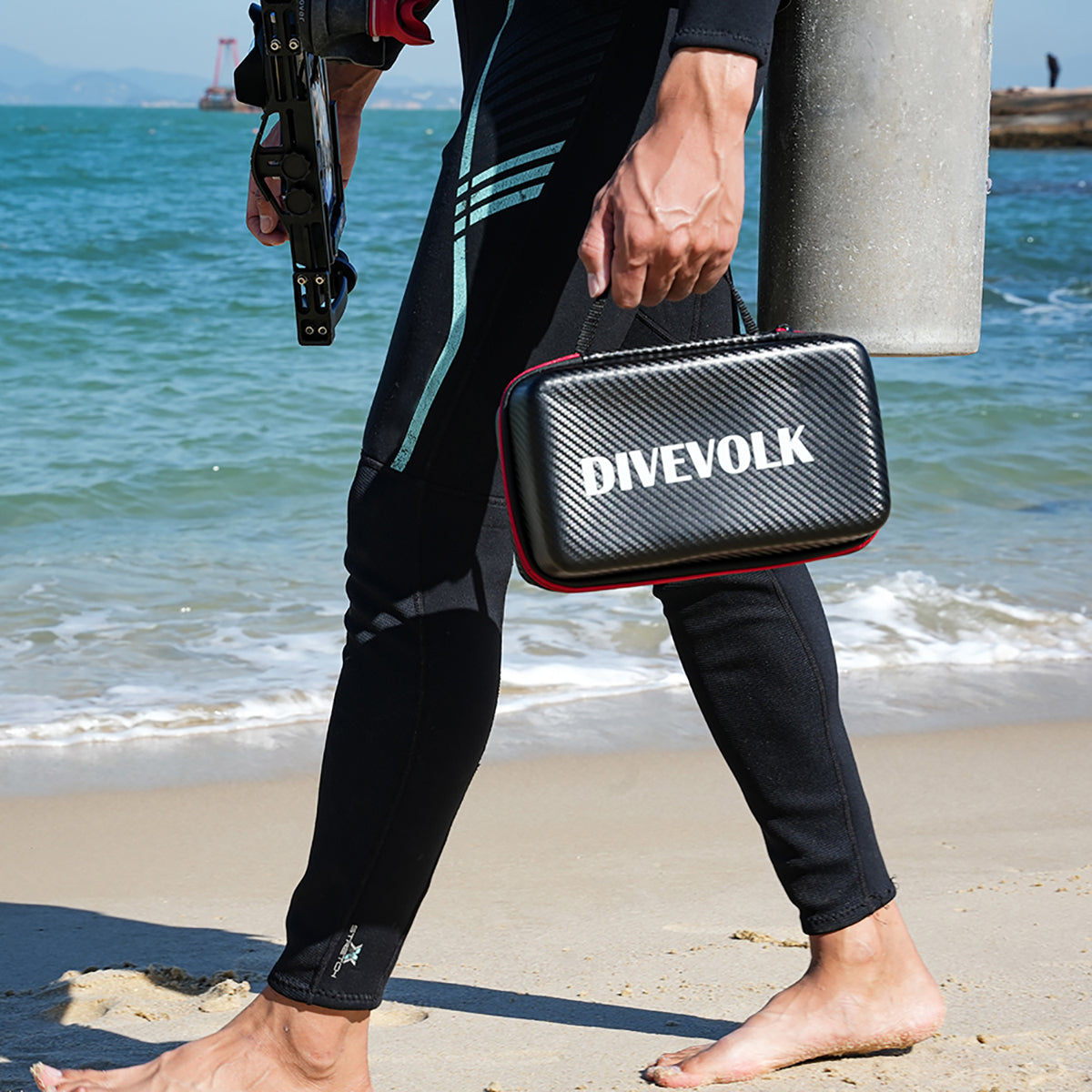
Beyond dedicated PLBs, your smartphone can itself become a surface rescue tool — if it's protected. DIVEVOLK's SeaTouch 4 Max underwater housing keeps your phone sealed and operational to 60 meters, and critically, it enables satellite phone calls and GPS navigation at the surface — even in areas with zero cell coverage. In a drift scenario like Redang, a diver surfacing with a SeaTouch 4 Max could immediately trigger a satellite SOS, share exact GPS coordinates with rescuers, or navigate toward the nearest landmass — capabilities that could compress a 12-hour ordeal into a rapid recovery.
How to Choose a Responsible Dive Operator
Equipment can save your life at the surface. But the Mersing tragedy teaches a harder lesson: the most dangerous piece of equipment on a dive trip is an irresponsible operator.
Before booking, ask pointed questions and watch for red flags:
- Crew certifications: Are the dive master and boat captain properly licensed? Request proof. The Mersing boat captain was intoxicated on a controlled substance — a fact that only emerged after a teenager was dead.
- Diver-to-guide ratio: Industry best practice is no more than 4-6 divers per guide for open-water dives. If you're in a group of 12 with one guide, you're a statistic waiting to happen.
- Dive briefing quality: A thorough briefing covers the dive site, current conditions, maximum depth and time, buddy assignments, separation procedures, and emergency protocols. If the briefing is rushed or skipped entirely, abort the dive.
- Roll call and surface protocols: Does the operator count divers before and after every dive? Is there a designated surface watch? In the Mersing case, the boat left the area without confirming all divers had surfaced.
- Emergency action plan: Ask to see it. A reputable operator will have a written plan covering diver separation, medical emergencies, and communication with coast guard or rescue services.
Building strong foundational skills through a rigorous open water certification program teaches you to evaluate these factors. The discipline you learn in training — emergency protocol adherence, situational awareness, conservative planning — is ultimately what separates divers who survive incidents from those who don't.

The Takeaway
Shahimi and Tan survived 12 hours adrift because they did the fundamentals right: they stayed together, maintained buoyancy, and waited. But they also got lucky — lucky that the current pushed them toward an island rather than open ocean, and lucky that searchers expanded the perimeter far enough to find them.
Luck is not a dive plan. A surface marker buoy, a personal locator beacon, verified operator credentials, and a rehearsed separation protocol — these are a dive plan. The gear exists. The knowledge exists. The only variable is whether you choose to carry them before the current decides for you.
Whether you dive Redang's coral gardens, Mersing's offshore pinnacles, or any current-prone site worldwide, the equation is the same: prepare for separation as if it's inevitable, and carry the tools to make it survivable. Because in open water, the margin between a rescue story and a tragedy is measured in the decisions you made before you got wet.