
Satellite messaging on a phone is the most oversold safety feature in diving right now, and it is also genuinely useful. Both of those are true, and the difference between them is decided months before the dive, at the point where somebody writes down who calls whom, on what, and after how long. A phone with a satellite icon is one line in that document. It is not the document.
This article is about building the document. If you want the feature-by-feature breakdown of what Apple's satellite services currently do, we covered that separately in iPhone satellite features at remote dive sites. Here the question is narrower: you are 40 kilometers offshore, someone surfaces in trouble, and the plan you wrote in advance is about to be the only thing that helps.
A Note on the iPhone 18 Pro
Apple has not released the iPhone 18 Pro. There is no specification sheet, no confirmed satellite capability and no coverage map, so nothing in this article is a claim about that phone. What we can say is that the surface-safety plan described below does not depend on which handset ships. The requirements come from radio physics and from how maritime rescue is organized, and neither of those is updated by a keynote.
Everything factual here refers to Apple's current satellite services on eligible models. When a new phone arrives, verify its eligibility for your exact purchase region, destination country, carrier and account on Apple's live pages before the trip, not from an article. Availability for these features has always varied by market and has changed more than once.
Write the Plan Before You Leave the Dock
A remote-site emergency plan is a short document with names in it. The version that works answers five things in writing, agreed with the operator rather than assumed about them.

First, the layer order. Which device carries the first call for help, and who on the vessel is trained and authorized to operate it? On most dive boats that is the marine radio, and DAN's boat-safety equipment guidance is clear that a vessel should carry more than one method of communication. A phone belongs somewhere in that order, usually near the bottom, and it belongs there by decision rather than by default.
Second, the beacon. Does the vessel carry a registered EPIRB, is the registration current, and who is authorized to activate it? If divers carry personal locator beacons, the same questions apply to each one. Registration is what turns an alert into a name, a vessel and a contact list at the rescue coordination center.
Third, the overdue clock. This is the item most often left vague and the one that costs the most time. At what point does a diver who has not surfaced become a search, and who starts it? At what point does a missed radio check-in become a call to shore? Write the minutes down. In the moment, nobody wants to be the person who declares an emergency, and a number on paper makes that decision for them.
Fourth, the shore end. Somebody who is not on the boat needs the float plan: departure time, dive sites, expected return, number of people aboard, and what to do if the return time passes with no contact. A satellite message is worth very little if the person who receives it does not know what it means or who to phone.
Fifth, the medical path. Nearest recompression facility, the emergency number for the jurisdiction you are actually in, the operator's evacuation arrangement, and where the oxygen kit is stowed. Our liveaboard safety checklist covers what to ask an operator about all of this before you book, and the practical dive-risk guide covers the go and no-go thinking that sits underneath it.
Where the Phone Sits in That Order
Apple's Emergency SOS via satellite instructions tell users to try the local emergency number first and describe a structured text exchange for when normal networks are unavailable. Apple's Messages via satellite page covers a separate, non-emergency service with its own market and account conditions. They are different services with different rules, and neither promises connection, delivery, a reply or a rescue.
That makes a phone a supplemental layer with two honest jobs at a remote site. It can raise an alert when the radio has failed or the vessel is out of range of anything monitoring, and it can carry detail that a beacon cannot: how many people, what happened, what injuries, what the boat looks like. A 406 MHz beacon transmits a position and an identity, which is exactly the right thing to do and the wrong tool for describing a suspected decompression injury.
What it cannot do is arrive first. Satellite messaging needs a clear view of the sky and horizon, the phone held in the open rather than in a pocket, and often a prompt to turn or move. On a deck in a swell with an unconscious diver, that is a job for a second person while the first is doing patient care.
What the Housing Does at the Surface
The reason any of this matters is that the phone has to survive the dive and be reachable when you need it. A phone in a dry bag in the cabin is not part of your plan, and a phone in a wet BCD pocket is a phone you will be drying instead of using.

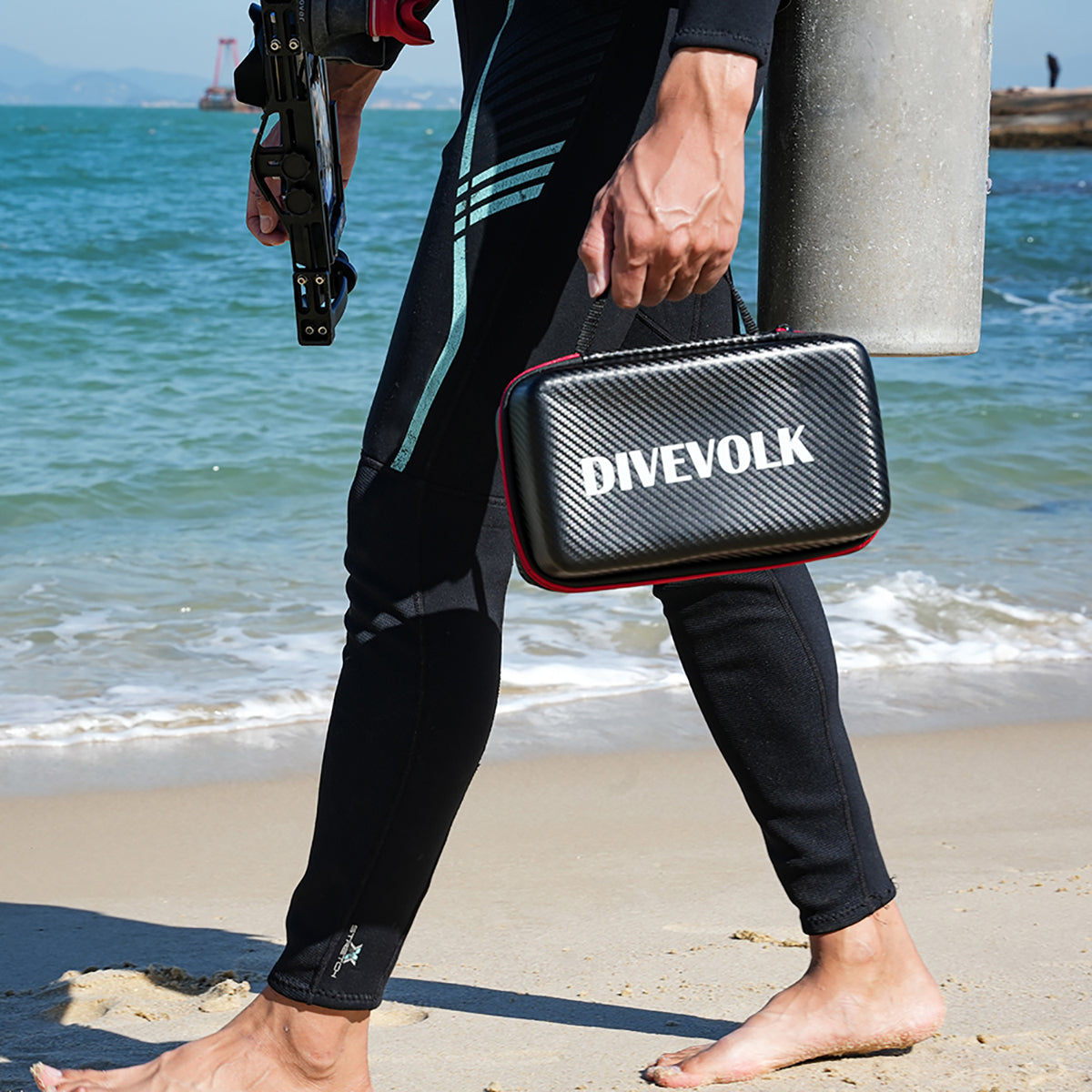
Cellular and GPS signals pass through the SeaTouch 6 Pro's engineering-plastic body, so at the surface, still sealed, you can check your position, call the boat or reach the operator without opening anything on a wet deck. That is not a theoretical capability. A divemaster named John, pushed offshore by strong current with his wife after a dive near Saba, reached help using the phone inside his DIVEVOLK housing while they were still in the water. We published the full account of that rescue because it is the clearest example we have of a housing keeping a phone usable at the moment it counted.
Satellite is the deliberate exception. Apple's satellite connection guidance requires an unobstructed view of the sky and a phone held naturally, and DIVEVOLK publishes no verified test of satellite performance through a sealed housing. So build the plan around taking the phone out of the housing once you are aboard or ashore and dry enough to do it safely. Camera in the housing, satellite out of it.
Underwater, none of this applies. Radio does not travel through seawater, so no satellite service, cellular call or position fix reaches a diver at depth in any housing from any manufacturer. The SeaLink transmitter exists precisely because the only way to get a signal out of the water is to float something on top of it, and it works to 30 meters, not to the housing's rated depth.
The First Ten Minutes After a Bad Surfacing
The sequence below is the plan's shape, not medical or rescue-command advice. The exact order belongs to the captain, the operator's emergency action plan and the law where you are diving.

- Get the diver aboard or supported, do the head count, and start care under your training. Oxygen and monitoring come before anyone touches a phone.
- Tell the person in charge. Do not run a parallel, quiet rescue attempt from the back of the boat.
- Split the roles. One person on care, one on communications, the captain on the vessel. A single person trying to do all three is how the radio call gets forgotten.
- Use the primary layer. Radio, then the local emergency number if there is any cellular coverage at all. Apple's own instruction is to try the local number first, because another carrier's network may take the call when yours will not.
- Fix your position and write it down with the time. Responders will ask for it, and if the situation gets worse it becomes the centre of the search area.
- If the primary layers fail, move to the phone. Take it out of the housing, get to open sky without leaving patient care or leaning over the side, and follow whatever the live interface asks for.
- Keep the beacon decision live. Activating it is a plan decision made by the authorized person, and it is not cancelled by a text message going out.
- Record what happened afterward: times, states, what was sent, what came back, what failed.
Nothing on that list moves in front of ascent, buoyancy, or a decompression obligation. Never shorten an ascent to reach a signal, and never leave a diver unsupported at the surface while someone stares at a screen. The lessons from the search covered in our Pulau Redang missing-diver analysis are mostly about how long the surface phase lasted before anyone escalated.
Rehearse Without Calling for Help
You cannot practice Emergency SOS, and you must not. False distress traffic is an offense in most jurisdictions and it pulls resources away from real incidents. Never activate a beacon, send a mayday, or trigger an emergency service to test a feature or make content.
What you can do on dry land, before the trip, is confirm the exact phone, software version and account are eligible for the service in the destination country. Run Apple's supported connection demo in open terrain. Set up Medical ID and emergency contacts. If you plan to use location sharing, configure it before you leave coverage, because it cannot be set up afterward. Save the operator's contacts, the local emergency numbers and the site coordinates offline. Then have the person who will actually be holding the phone do all of that once, rather than the person who read about it.
Three Things That Do Not Change
An acknowledgement is not a rescue. NOAA's SARSAT guidance is explicit that a Return Link Service confirmation means the alert was detected and forwarded, not that anything has launched. The same discipline applies to a delivered message.
Silence is not a failure and it is not a success. If a message shows as sent and nothing comes back, you have learned nothing about whether help is coming. Keep working the other layers.
And the phone is never the reason a dive plan changes. It is not a dive computer, a point we made at length in why a smartphone does not replace a dive computer, and it is not a beacon, a radio or a flotation device.
Before the next remote trip, work through the scuba diving safety essentials with your buddy and put the five plan items above in writing with the operator. If you want the phone to be usable at the surface when the plan reaches that line, check the current compatibility list and manual through DIVEVOLK technical support for your exact handset.