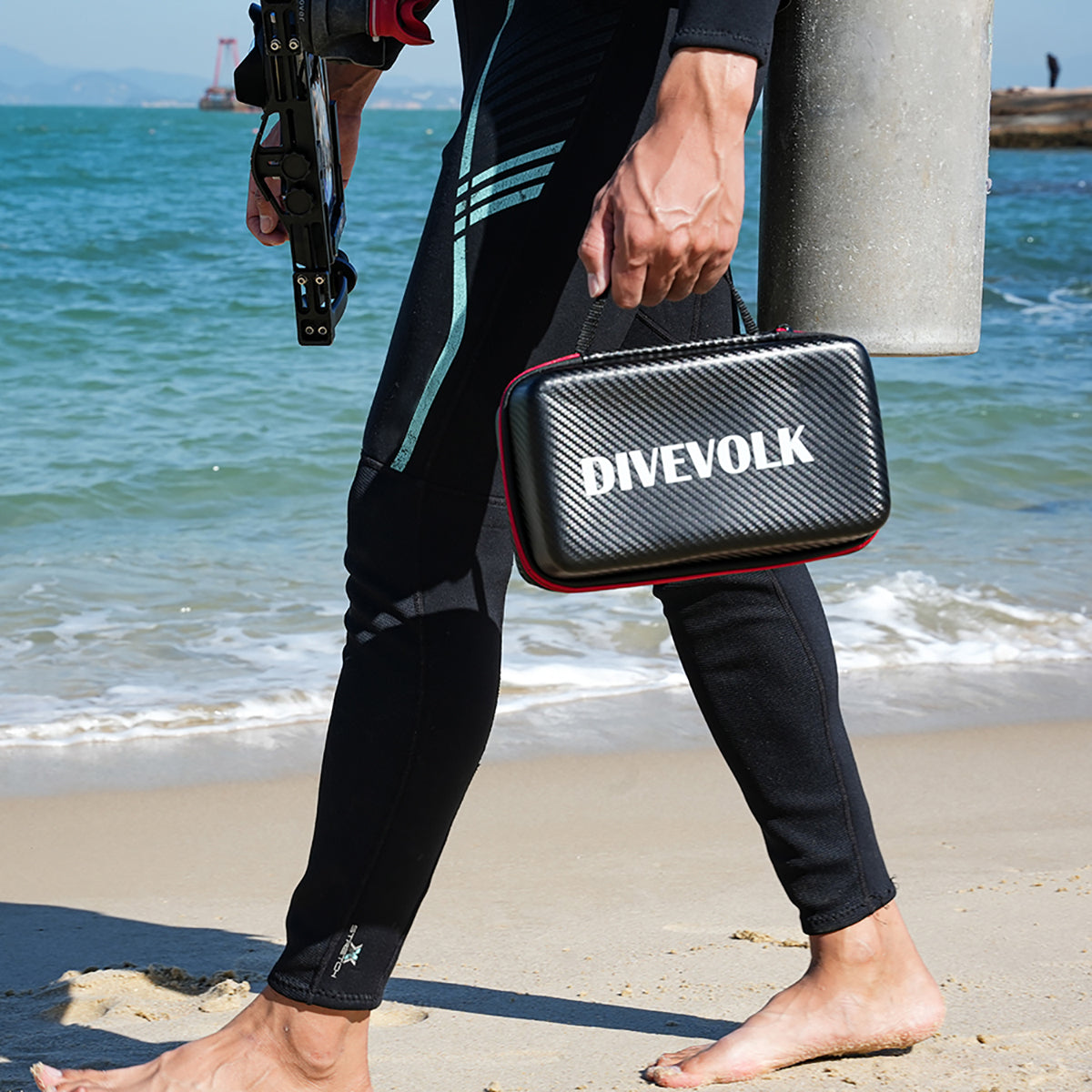

On June 28, 2026, Chen Xiaodai (陈小歹), a dive-gear review creator on Xiaohongshu (RED), went live from a reef in Puerto Galera, Philippines. No production boat, no camera operator, no studio. One diver, a phone in an underwater housing, and a DIVEVOLK SeaLink transmitter carried the dive into a live room while followers watched and typed questions in real time.
The title of the RED note that came out of the trip sums up how the creator saw it: they carried more than 9 kg of livestream gear abroad to run a real dive livestream in "PG," as divers call Puerto Galera. That number is Chen Xiaodai's own description of their luggage, and it says a lot about what solo underwater streaming involves. Everything a TV crew would split among several people has to fit into one diver's bags and one diver's attention span.

One Person, Every Job
The screen recordings of the stream show what that looks like from the viewer's side. The live view moves with the diver: a slow swim over sand and hard coral, a pause at an anemone, a turn of the phone to show the creator's own face behind the mask. Between reef shots, Chen Xiaodai points the lens back at themself and talks to the audience.

That is the real difference between a creator stream and an event broadcast. At a competition or an aquarium show, a surface team handles the network, an operator handles the camera and a host handles the audience. A solo creator is the diver, the camera operator, the host and the moderator at once, and they still have to run a safe dive. The equipment has to stay simple enough that the stream does not take over the dive.
How the Feed Gets Out of the Water
A phone loses its connection as soon as it goes underwater. Wi-Fi and cellular signals simply do not travel through water the way they do through air. SeaLink solves that by giving the phone a link to the surface. The phone stays sealed in a DIVEVOLK underwater housing, a floating surface unit holds the SIM card and handles mobile coverage above the waterline, and the phone stays online at depths of up to 30 meters.
Because the phone itself stays connected, the creator does not need special broadcast software. The stream runs in the same app and on the same account they use on land, so followers find them in the usual place. Independent reviewers have reached similar conclusions: Scuba Diver Magazine's SeaLink review describes the kit as bridging the gap between the surface and the depths, and that is the part that matters for a one-person channel. The underwater view reaches followers while the dive is still happening, not hours later as an edited upload.
The housing matters just as much as the link. A SeaTouch housing is a button-free, full-touchscreen design, so the diver works the phone through the touch membrane with the same gestures used on land. For a streamer, that means switching cameras, checking the live room and reading comments without memorizing a set of mechanical controls. The SeaTouch 6 Pro is the latest housing in the range built around that idea.
The Chat Steers the Dive
The most telling moments in the footage are not the prettiest reef shots. They are the exchanges. About a minute into one recording, a viewer types a simple question: how deep is this? Seconds later, Chen Xiaodai raises their wrist to the lens and holds the dive computer in frame. The display reads just over 9 meters, and another viewer types "9 m" back into the chat. The next question arrives right away, asking how they keep their mask from fogging.
Earlier, the camera lingered on a bright orange shape tucked into a reef crevice. A viewer asked what it was, and another answered in the chat that it was an electric clam, the reef bivalve divers know for the flickering light along its lip. It shows how a live audience behaves differently from a recorded one. People ask, other viewers answer, and the creator can respond while the subject is still in frame.
Many comments were about the technology itself. Viewers asked how there could be signal underwater, how many meters down the stream could go, whether it would still work at 20 meters, and whether a filter was being used. Others wrote that now they knew how a dive livestream works, or that it was impressive that diving could now be streamed at all. For a gear-review channel, those questions are content in their own right: the audience is watching the equipment perform live, not hearing about it afterward.
Viewers also commented on sound. Several wrote that they could hear Chen Xiaodai clearly, one said it was clear for someone talking underwater, and another wished the audio were a little clearer. Creators who want broadcast-quality voice can look at a full face mask paired with the DIVEVOLK Wireless Microphone Transmitter, which sends the diver's voice into the same SeaLink stream.
What Puerto Galera Put on Screen
Puerto Galera sits on the Verde Island Passage between Luzon and Mindoro. Rappler reported that a 2015 California Academy of Sciences expedition in the passage found more than 100 marine species, many previously unknown to science, including dozens of new nudibranchs at a site near Puerto Galera. The live feed showed a share of that variety: clownfish in a dense anemone field, schools of yellow-striped fish over the reef slope, a blue sea star on the coral and fish crowding a wreck.

One viewer reacted to a clownfish swimming head-on toward the lens by calling it soothing to watch. Another asked Chen Xiaodai to go and find batfish. That kind of request is exactly what keeps people in a live room. It is also something the diver has to handle with judgment: the dive plan, the buddy and the reef come before any request from the chat.

Why SeaLink Matters for Independent Streamers
For a creator who streams for a living, underwater live content is hard to copy. Most travel and gear channels can only post a recap after the trip. A creator who can take followers along on the dive itself offers something their feed rarely sees, and the chat turns it into a two-way show. Viewers send likes and gifts, new people join from the platform's recommendations, and the creator answers them from the reef.
It also changes the cost of entry. Underwater broadcasting used to mean dedicated cameras, cables and a surface crew. Chen Xiaodai's stream shows the same core idea scaled down to what one person can pack: a phone, a SeaLink transmitter and a housing. Event teams, like the crew behind the 2026 China Freediving All-Round Open broadcast, still have a place. But independent creators no longer need one to go live below the surface. Other channels, such as Dive Dive Live, have shown how much a full touchscreen helps once the stream is running.

Notes for Solo Diver-Streamers
- Plan the dive first, the stream second. Filming adds task load. DAN's guide to dive skills for underwater photographers is a good reminder that buoyancy, awareness and buddy contact come before the shot.
- Answer the chat from a stable position. Stop, hold your buoyancy and keep clear of the reef before you read comments or turn the camera on yourself. Never steady yourself on coral or touch marine life for a better angle.
- Keep an eye on your gas. Viewers in this stream asked whether talking uses more air and how much was left. Those are fair questions. Check your gauge more often than usual when you are narrating.
- Sort out mask fog before you go live. A fogged mask makes it hard to read the screen. PADI's tips for preventing mask fog cover the basics.
Chen Xiaodai's Puerto Galera stream was not a staged demo. It was one creator, a heavy bag of gear and an audience that wanted to see the dive as it happened. If you are a creator planning your own underwater live content and want help choosing a setup, contact the DIVEVOLK team.