
By Steven Cross
This might sound shocking, but I'm 70 years old and began diving at 64. And yes, the learning curve to get in the water, and take a plunge like this, was very, very hard. With about 44 dives under my belt, I am entirely, and completely, a novice. But, I sure am an enthusiastic one! My daughter was the one who pushed me into this, as she's an experienced diver, and a professional paid one at that. When she showed me the photos and videos of her underwater encounters, I knew this was something I too had to do—no matter how painful or grueling the journey would be to get there. I wanted to be part of her world, as the places she was going and what she was getting to see was breathtaking.
Over the years, my daughter and I have traveled the world together, dive site after dive site. From California's kelp forests and their temperate (oh so temperate) waters to the remote Western Australia's Ningaloo Reef all the way to Bahamas, Belize, and Florida to look for prehistoric megalodon teeth, we've seen a lot of stuff together. And I've watched her document it all. I wondered when my day would come to take up underwater photography and get involved. But first, I had to get over the sheer panic of not knowing how to use my gear properly before that day could come. She has written about how DIVEVOLK became part of her Edges of Earth expedition kit.

Steve Cross diving in Belize. Photo Credit: Adam Moore
It finally happened last year on a ten day trip to Bonaire. Where the whole thing clicked into place and I felt ready to up my game. To look a little closer and to take matters into my own hands on what content I could capture when exploring our great blue planet. While my daughter's camera gear was massive and cumbersome, taking her nearly 30 minutes to assemble and an hour to take apart, clean, dry and pack away, I wanted something far easier that would still take great quality underwater content. And, I wanted to use my cellphone. The thing is, I love the photos my phone takes, and I didn't want to have to lug around another, separate camera, when the one in my hand works just as well as anything else! Plus, I wanted to get out of the water, make a few edits, and send off to my friends who hardly believe I actually dive!
So, like any good 70 year old, I took to the internet. One thing you must know about me is that I'm a researcher, through and through. I don't leave any stone unturned when I'm looking to make a purchase. I started my search by reading reviews, which got me a good idea of what was out there. But then, I turned to YouTube and came across a review by underwater explorer and photographer, Nick Derutter, from the channel Dive Saga. He opened by saying, "I will never take my cell phone underwater. Never." That got my attention. But he went on to talk about a product called the DIVEVOLK SeaTouch 4 Max. He had spent time testing the housing device that brought this iPhone underwater, and he felt obligated to give it a fair evaluation by putting it through the ringer. By the end of the review, he gave it two thumbs up. He was genuinely impressed.

Andi Cross getting ready for a dive with DIVEVOLK. Photo Credit: Adam Moore
I watched other reviews, studied tutorials, took notes, and decided I was ready to try underwater photography for the first time using this very device. Why? Because for someone like me just getting started, there was no question this would be easy to manage, and also would allow me to use a camera I was already familiar with. Phones, action cameras, compacts and DSLRs all have their place, and a side-by-side underwater camera guide explains why the phone is the most accessible choice.
When we arrived in Bonaire, I did a few dives to test the waters, and wow, I was in shock. This place was a diver's paradise, and there was no way I was spending over a week here without getting some content for myself. So, I took the time to test the device in the pool, in the sink, in the bathtub. I wanted ZERO to go wrong when I was underwater diving. Based on recommendations, I added the red filter to restore natural underwater color and attached a wide-angle lens. Both accessories connected quickly and securely. The housing felt solid and well built. When I was holding it, I felt confident in the construction.

Getting a chance to start my underwater photography journey. Photo Credit: Steve Cross
The system uses a custom tray designed for your specific phone model. After adjusting a few phone settings—a process that takes only minutes—you place the phone in the tray, slide it into the housing, and tighten two metal screws to seal the unit. Once closed, it is completely watertight (those test-runs made me a full believer!) The back of the housing has a built-in touchscreen membrane that mirrors your phone's touchscreen, allowing you to operate it exactly as you would on land. Yes, the touchscreen works underwater, I can confirm! As freediver Adrian points out in his one-year SeaTouch 4 Max review, a new phone and tray also means an instant underwater camera upgrade.
My daughter's idea of a good day is diving as many times as possible, so I knew I was going to get my fair share of action with the DIVEVOLK in. On one of our dives, I descended with the DIVEVOLK in hand, excited and curious. Hitting neutral buoyancy, I started snapping! Then I switched to video using the touchscreen. I filmed schools of fish moving in formation, coral swaying with the current, and my daughter diving in slow motion, as she likes to do. I was, without question, completely hooked.

Great quality and great construction. Photo Credit: Adam Moore
Back on land, I was eager to see if I had destroyed my phone or not, diving around 20 meters. The phone was bone dry. We immediately reviewed the footage—no transfers and no extra steps. The photos were awesome and the videos were crisp, with impressive natural color thanks to the red filter. I was amazed. On my very first attempt, I had captured beautiful underwater content. Within minutes, I sent videos to friends back home, proving that yes, I am in fact a real diver even in my seventh decade on earth. Rescue instructor Miguel Ollero says the same worry lasted exactly one dive in his skeptic's take on the SeaTouch.
There are practical advantages to the DIVEVOLK too, might I add. On a dive requiring a long decompression stop, you could watch downloaded content underwater using the touchscreen. And in a worst-case scenario—surfacing to find the boat gone—your phone is immediately accessible once you're back on the surface. That peace of mind matters (at least I could assume so for divers in situations like that!) Japanese YouTuber Shiro Dive makes the same point about calling the boat in his SeaTouch 4 Max PLUS breakdown.
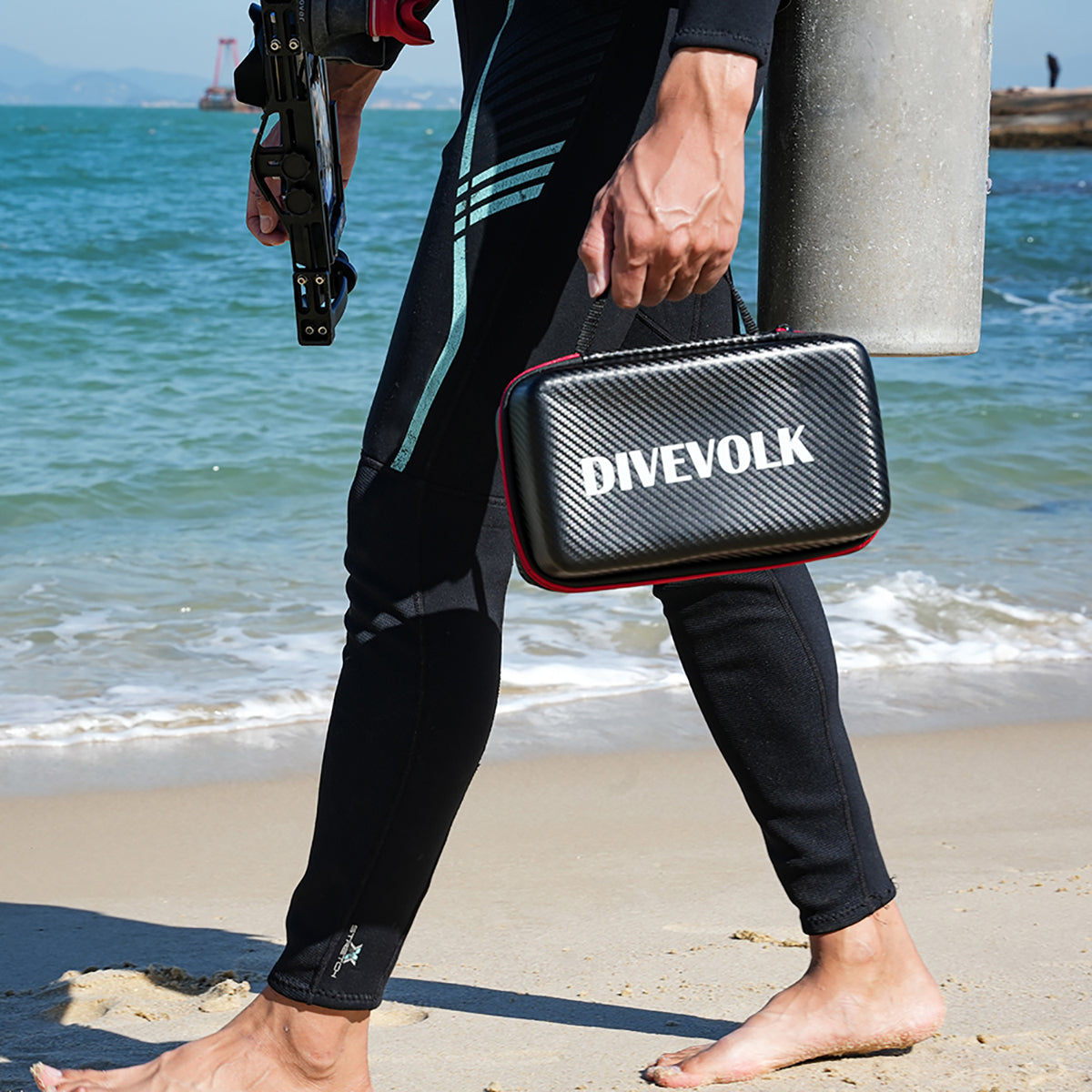
If you're wondering, my kit included a few different phone trays (depending on what models you use), a 67mm lens adapter with expansion clamp, a red filter, a 0.6x wide-angle lens, a protective cover, and a travel case. Additional accessories such as lights and mounting arms are also available, which are up next for my next adventures. Anyone curious about a fuller setup can see how the Creator Kit and Pro Macro Lens performed on dives in the UK and Menorca.

My DIVEVOLK travel case and device, small and easy. Photo Credit: Adam Moore
For anyone considering underwater photography, this is an accessible option. Pricing generally starts around $239 depending on the bundle. Setup is so straightforward, I cannot emphasize this enough! The unit is compact meaning that traveling with it is a breeze—you just put it in your carry on and off you go. Your content stays on your phone, ready to share or transfer. There's no learning curve with complicated editing software or proprietary file systems, which for someone like me, means a lot.
For a 70-year-old novice who wanted to be part of the action, and take my diving to the next level no doubt, the DIVEVOLK made the process simple and fun. I give it a 10 out of 10 for divers, whether beginner or experienced, who want to capture what they see beneath the surface, bring it home to share, and prove that what's down there is worth seeing and protecting now and in the future. I never thought in a million years this would be my reality, but it is and I'm extremely grateful. I'm in good company, too: mobile journalism professor Rob Layton has relied on DIVEVOLK for five years of pro surf photography.

Steve's favorite photo from the trip. Photo Credit: Steve Cross
About the Author
Steven Cross is a 70-year-old novice diver who began his underwater journey at 64, inspired by his daughter Andi Cross, co-founder of Edges of Earth. With 44 dives across California, Western Australia, Bahamas, Belize, Florida, and Bonaire, Steve proves it's never too late to explore the underwater world.
- Andi Cross on Instagram: @andicross1
- Edges of Earth on Instagram: @edgesofearth_
- Edges of Earth website: edgesofearth.com
- Photographer Adam Moore on Instagram: @adammoore1
Ready to start your own underwater photography journey? Explore the DIVEVOLK SeaTouch 4 Max kits and see why divers of all levels trust it beneath the surface. Need help choosing the right setup? Visit our technical support page or contact us.