
Originally published in DYK Magazine (Dyk Magazine 82) by Stefan Beskow, a Swedish underwater photographer and writer with over 25 years of experience. Stefan is an ambassador for MARES and Sea&Sea. This article has been translated from Swedish and republished with permission.

Stefan Beskow testing underwater smartphone photography equipment
The Mobile Phone Revolution in Photography
There is no doubt that the mobile phone has fundamentally changed our photography habits. Nowadays, many people have completely abandoned compact cameras and photograph exclusively with their phones. Moreover, smartphone cameras have gotten significantly better. In premium mobile devices, the image quality can be stunningly impressive!
The traditional entry point for most underwater photographers and videographers has been to start with a simple compact camera and then add strobes, lighting, and perhaps wet lenses for both macro and wide-angle photography. In recent years, however, a number of manufacturers have developed underwater housings for smartphones, opening up new possibilities for aspiring underwater content creators.
Two Approaches to Smartphone Underwater Housings
You can roughly divide underwater smartphone housings into two camps:
Traditional App-Controlled Housings
The first category consists of more traditional housings that are controlled via an app and Bluetooth with a proper shutter button but without access to use the touchscreen as you can on land. These housings often have a vacuum system that signals when there's a leak, which can, in theory, make the risk of leakage lower.
Touchscreen-Enabled Housings
The second category allows you to use the touchscreen and all the features that the phone has without being locked into a specific app. However, they currently lack (at present) the ability to integrate a vacuum system.

Full touchscreen access underwater with DIVEVOLK housing
Testing the DIVEVOLK SeaTouch 4 Max Housing
I tested DIVEVOLK's smartphone housing to see how mobile housings compare against a "traditional" underwater camera. DIVEVOLK's SeaTouch 4 is a housing that allows you to use the phone's touchscreen thanks to a semi-soft membrane on the back that enables the phone to sense when you press on the outside of the membrane.
This means you can access all of the phone's apps and are not bound by a specific app to use the camera underwater. I personally believe that the ability to use the screen and have full access to all apps will become increasingly common among mobile underwater housings. It makes the difference virtually non-existent compared to how you use your phone on land. Everything works as usual—you can just "get started" since everything functions normally.
Camera Control and Shutter Options
To take photos and start video recording, you also use the screen, just like on the surface. If you want a real shutter button, DIVEVOLK has solved that too. You can purchase a Bluetooth-controlled shutter button that you can attach to the housing or to an optional external handle, without sacrificing the ability to use the touchscreen. Very convenient!
Unique Safety and Communication Features
The advantage of being able to access all apps on the phone opens up a lot of possibilities. One aspect of this is safety. You can use GPS on the surface and even make emergency calls if an accident should occur. Underwater, the phone can be used to communicate (write messages), which can also be useful.
Perhaps the phone can even be used by divers with diabetes as they can use the apps they use on the surface (though you should consult with your doctor first if this applies to you)? If you, like me, shoot with larger systems, you can beneficially bring your phone underwater as a backup camera and for extra security. Additionally, you can connect your camera to your phone and use it as a monitor.

Complete DIVEVOLK Ocean Kit setup
I personally see a use case even for experienced photographers to use a smartphone underwater housing as an extra housing in case something happens with the regular equipment, or if you're just doing a sporadic dive and don't want to bring your entire regular underwater camera system.
Build Quality and Design Features
The housing feels robust, and you place your phone on a small sled that is adapted to your specific phone model. This makes the housing suitable for most phones you might have. If you change phones, you only need to acquire a new sled for the housing to work with the new phone. Smart—and it means you don't have to buy new underwater housings as soon as you change phones, which makes the whole thing considerably cheaper!
Seal Design and Water Protection
The housing doesn't have a vacuum system, but the seal is smartly constructed to seal both on the side of the opening and on top of the opening. Since you insert the phone on a sled from the side, the opening is small, which further minimizes the area where leakage could occur. I found it easy to insert the phone, and DIVEVOLK's sealing solution feels secure.
Underwater Performance Testing
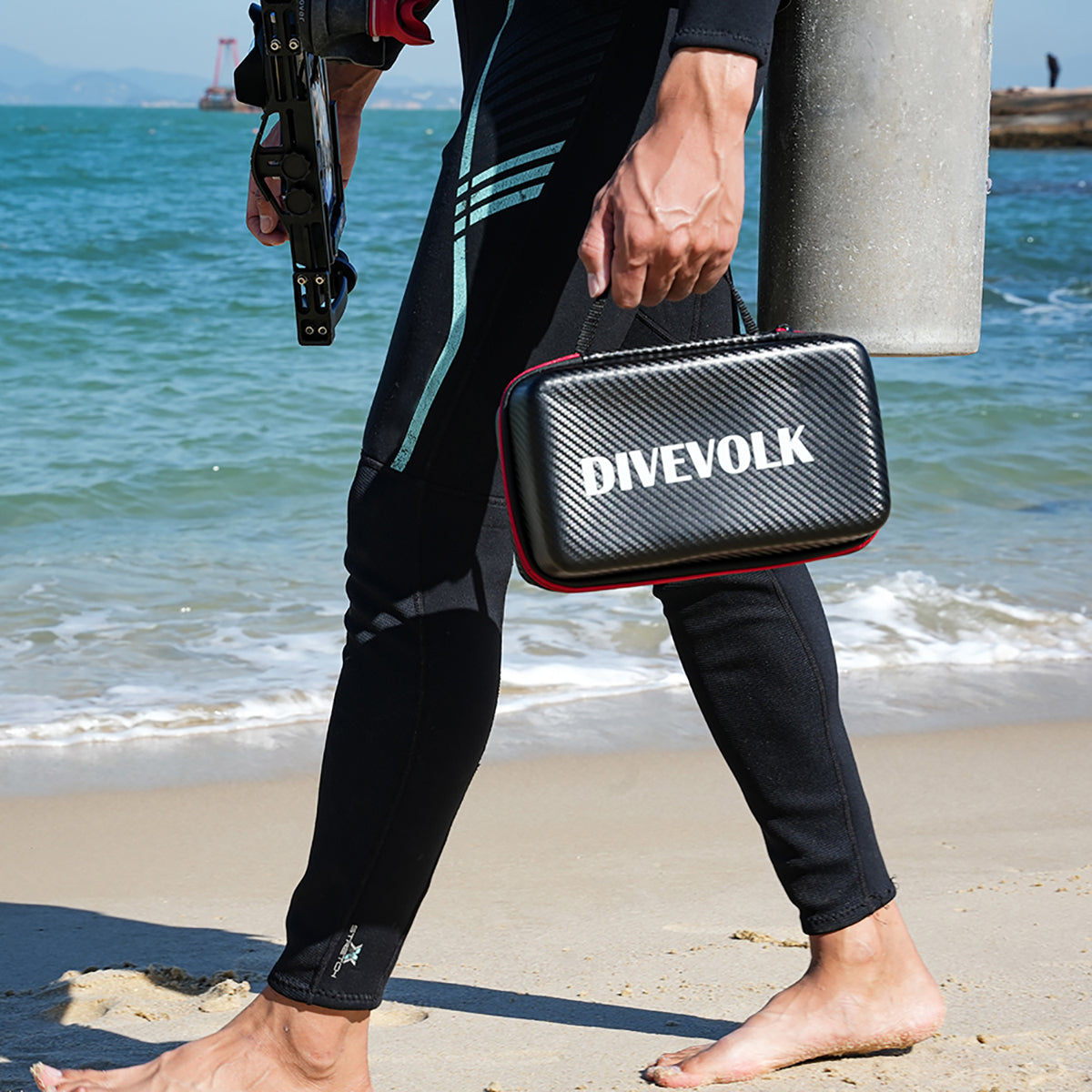
How does it feel in the water? Actually, quite nice! I used the Ocean Kit, which in addition to the SeaTouch Max 4 housing consists of a wide-angle lens, red filter, filter and lens holder, and a protective carrying case.

Real-world testing in Swedish waters
I also had external handles where I could attach a light, which is needed in Sweden. If you're only planning to use it abroad, you'll get far with just the red filter. Of course, the quality of photos and videos varies depending on which phone you have.
Cold Water Considerations
Personally, I missed having a proper shutter button in Swedish waters when I dive with gloves, since you become a bit clumsier with thick wetsuit gloves or drysuit gloves, and it can be difficult to hit the right spot among all the apps. But as I wrote above, that is available for purchase. When I tested the housing without gloves, I didn't experience any problems at all accessing the right apps underwater. So if you plan to use the housing in Sweden, it's recommended to purchase the additional shutter button.
Image Quality Results
My phone is a typical mid-range smartphone. Not the very best camera, but it works well enough. If you use a better phone, the image quality will be better too. I got the best results when I filmed with lighting. The phone handled white balance well and had no problems focusing. Additionally, any motion blur became less of an issue.

Professional-grade protection for smartphone underwater photography
Since there is currently no possibility to connect a strobe to the mobile housing, it's photography with a lamp that applies, so the strobe's advantage of "freezing" the subject and thus getting sharper images during photography is not possible. Despite this, I was positively surprised by the images I took, and if you have a slightly better phone, you'll get far with that image quality.
Young Diver Perspective: My Daughter's Experience
My daughter Majken, who is a fairly experienced diver but new to underwater photography, got to try a housing from DIVEVOLK (one with the pink color variant). Here's how she summarizes the dives she did with it:
"I love the color, the housing is beautiful! It was easy to access all functions and apps, and everything worked just like on land. It was harder to photograph underwater than on land, but much easier to film than to photograph. When I filmed, I got a clip of a moray eel that I'm very happy with! It was really fun anyway, and I'll bring my DIVEVOLK housing on my next dive trip!"
Final Verdict: The Perfect Entry Point
In summary, an underwater housing for smartphones is an excellent entry point into underwater photography and videography. The startup cost is not so daunting, you already know how to handle your phone camera, and the ability to expand the system is good.
Since you probably have your phone with you when you're traveling anyway, you have to say that it becomes a very compact and travel-friendly kit that easily fits in your carry-on luggage. This makes DIVEVOLK smartphone housings an ideal solution for both beginners taking their first underwater shots and experienced photographers looking for a lightweight backup system.
Key Advantages of Smartphone Underwater Photography
- Low Entry Cost: More affordable than traditional underwater camera systems
- Familiar Interface: Use the camera you already know how to operate
- Compact & Travel-Friendly: Fits easily in carry-on luggage
- Full App Access: Not limited to a single camera app underwater
- Safety Features: GPS, emergency calling, and underwater communication
- Expandable System: Add lenses, filters, and lighting as you grow
- Universal Compatibility: Just change the sled when upgrading phones
- Backup Solution: Perfect secondary system for experienced photographers
Learn More About DIVEVOLK Underwater Housings
Whether you're just starting your underwater photography journey or looking for a compact backup system, DIVEVOLK offers professional-grade smartphone housings that deliver exceptional performance at depths where it matters most.
For more information, visit: